And another week has past and 1 more week to our next episode! I hope I will be able to start a few feature on our podcast. This week, there aren't any new games (to me) that I would like to specially point out as being excellent and those that are above average are Quietville and Palastgefluster. Lets get on with the reviews!
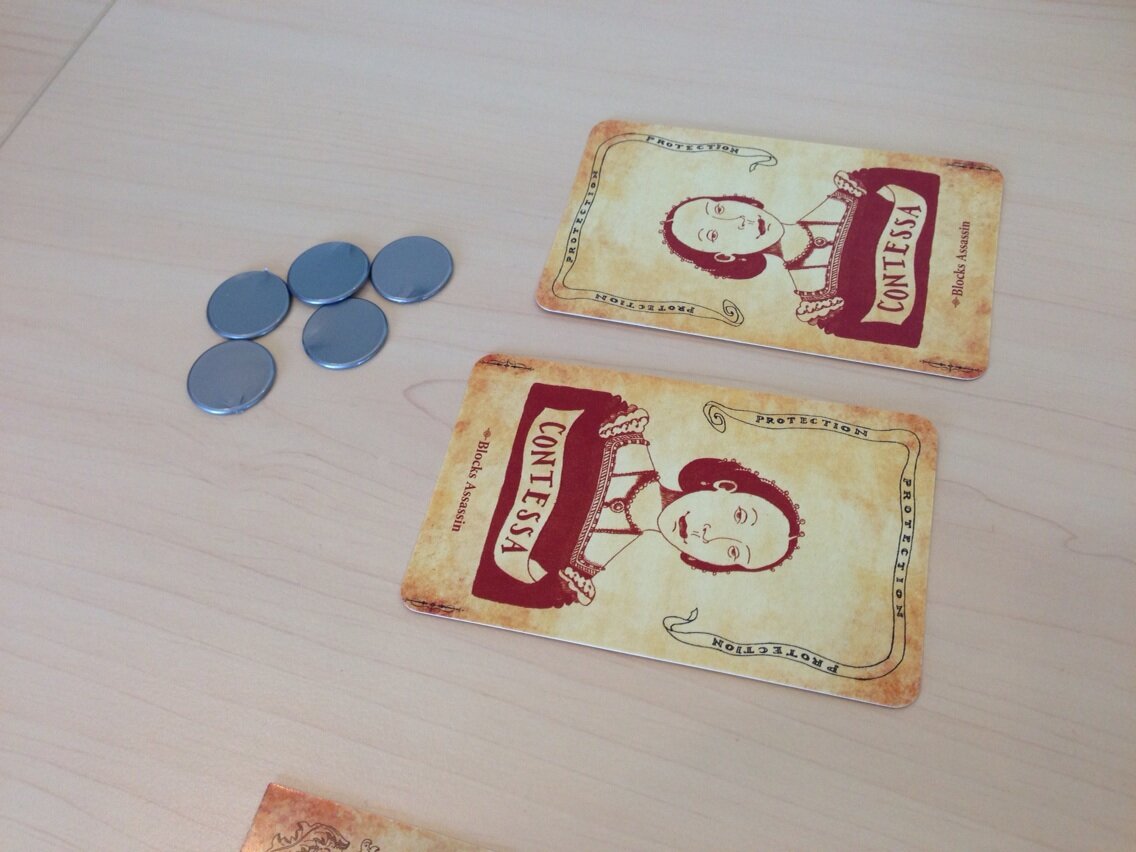
COUP
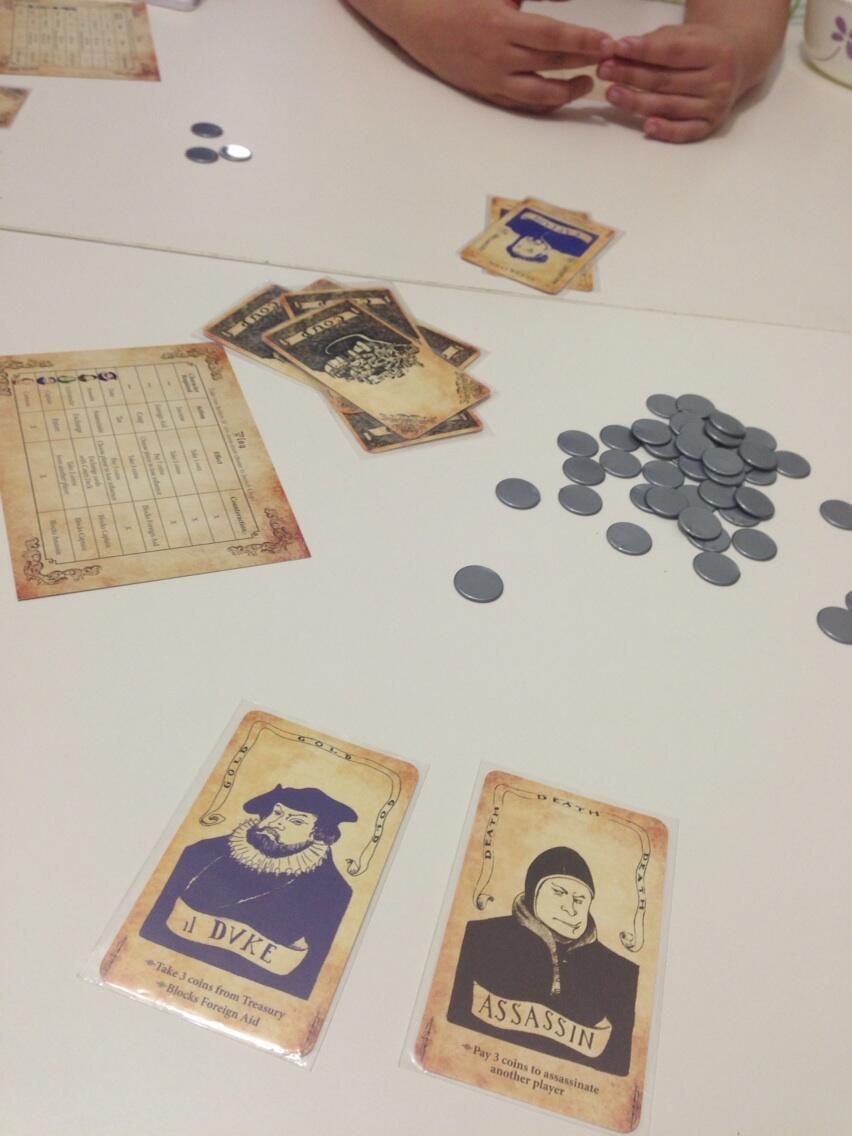 |
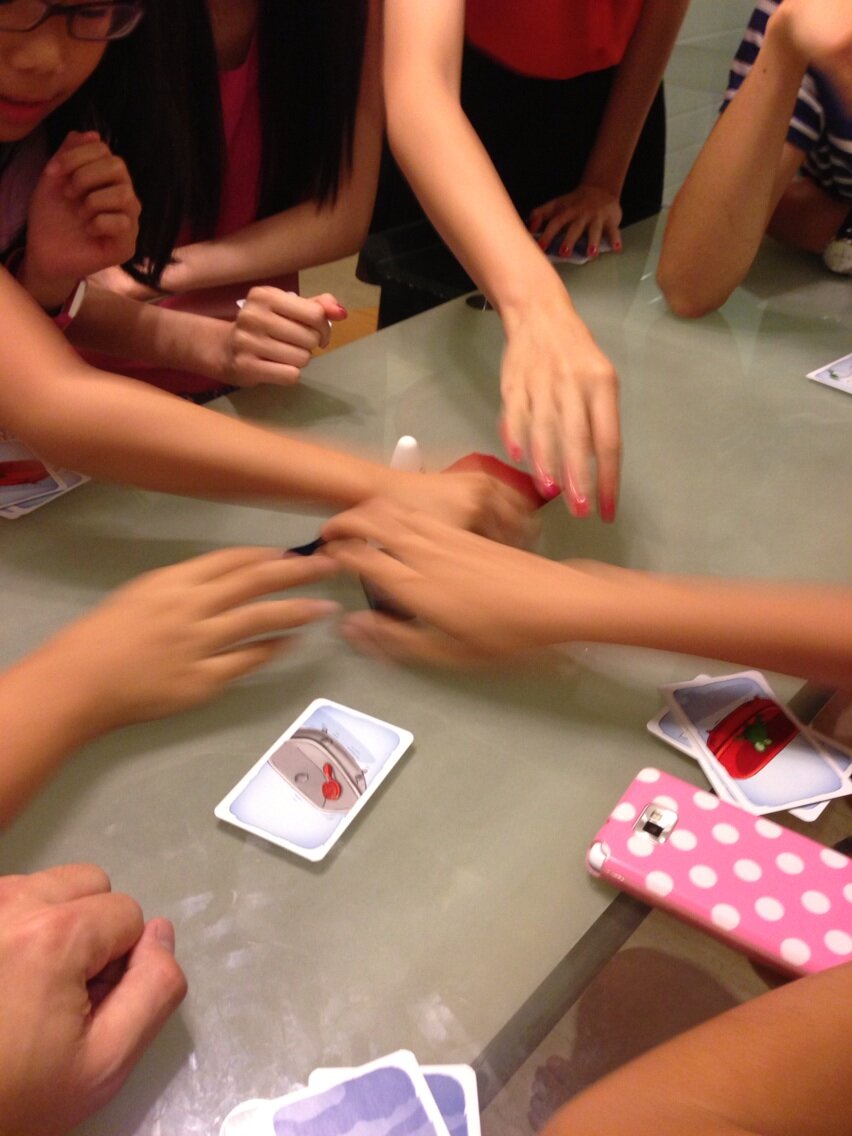
| Sigh i never seem to win at this... |
KINGS OF AIR AND STEAM
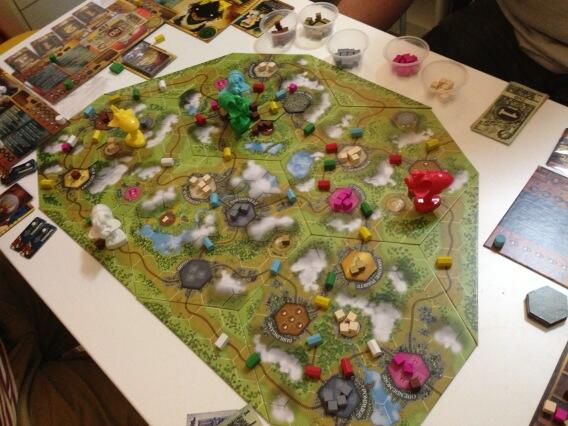 |
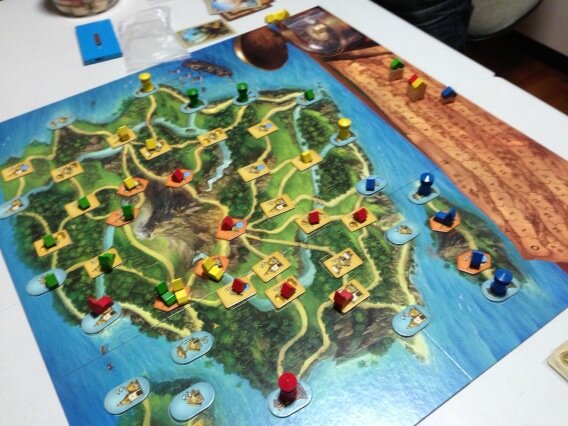
| 5 player game! Smaller map. |
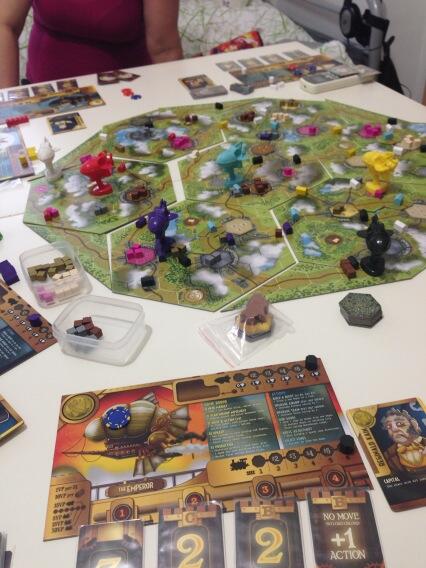 |
| 6 player game. All map tiles used! |
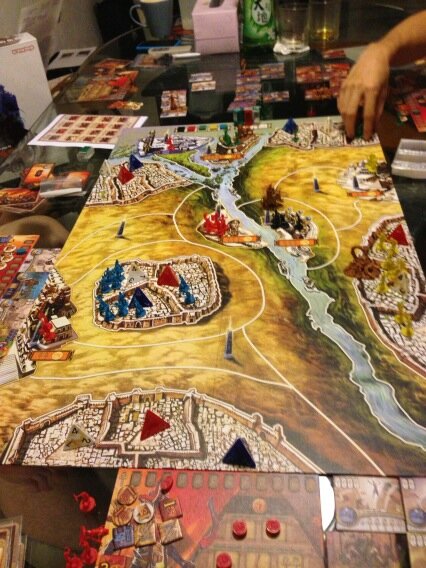
Game Session and Thoughts: Ah this is a Kickstarter-ed game and after watching the reviews from Joel Eddy, I was eager to grab myself a copy and see how it works with my groups. Gameplay wise its pretty straight forward. Players will have an airship and are flying around to the various factories on the board to pick up goods. Then they fly the airships to their own depots to drop off the goods and subsequently have their goods delivered to respective cities to earn money. After 5 rounds, whoever has the most VPs (in terms of money, built depots, upgraded airship and trains) will win the game. Simple right?
At the start, there will be a market phase where 3 tiles are revealed and the prices of the goods corresponding to the revealed tiles are increased. Next, players simultaneously decide from a deck of movement cards which 4 cards they will perform this round and place these cards faced down in 4 slots. This is very similar to Roborally. Once all players have committed their moves, all players will reveal the first card and depending on the letters on each card, move in alphabetical order. Move cards will usually have the number of spaces your airship can move and you must move all the steps. After you have moved, you can load and unload goods and then you can perform an action. Actions include building a depot, shipping goods (from Depot to City), upgrading your airship, upgrading your train (there's this invisible train that runs from your depots to other depots or cities), getting $3 from the bank or flight adjustment (move your airship 1 space). So play will continue this way until all 4 move+actions are done and then players will need to pay upkeep ($1 for every good in their cargo hold and depot) and then factories will produce (At least 1 per round). That will be the end of the round.
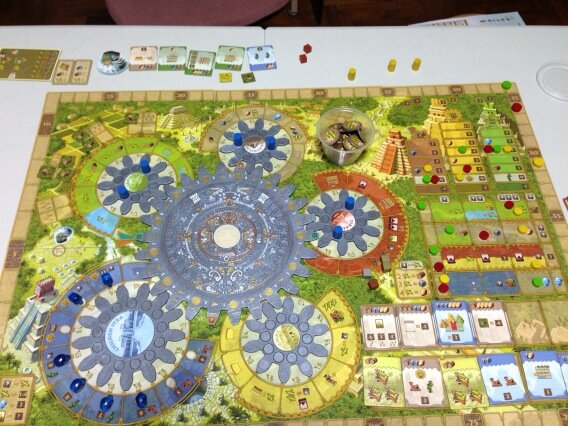
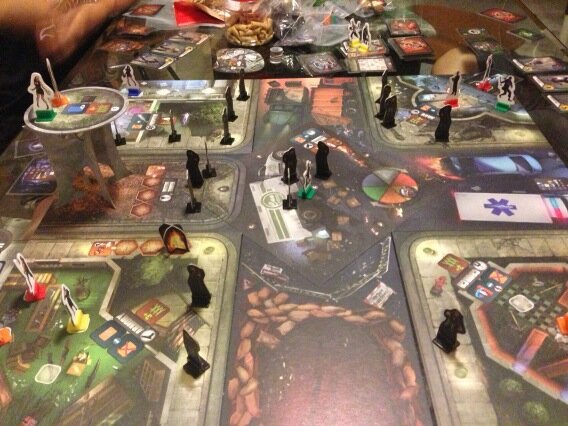
Now if you have seen the pictures, the components look very good. Goods are cubes which are ok, depots are little wooden houses which are also ok and the airships are nice big plastic airships and nicely detailed. The artwork is also very nice and every ship has a unique design and signature. Each player also has a unique character that they can choose from. The board itself when assembled really looked surreal as one player put it. The clouds floating across the cities and our airships flying around the board does make it feel all very thematic. Gameplay wise, its simple as I have already described above and easy to play. Teaching it though there are some bits that will require playing it one round to understand the concepts better. The paper money has a nice design on it though its paper which I did not prefer. So all in all, it played quite ok and is very straight forward. Fly around, pick up goods, drop off goods, deliver them, sell get money and upgrade your airship, trains and build depots.
At the start, there will be a market phase where 3 tiles are revealed and the prices of the goods corresponding to the revealed tiles are increased. Next, players simultaneously decide from a deck of movement cards which 4 cards they will perform this round and place these cards faced down in 4 slots. This is very similar to Roborally. Once all players have committed their moves, all players will reveal the first card and depending on the letters on each card, move in alphabetical order. Move cards will usually have the number of spaces your airship can move and you must move all the steps. After you have moved, you can load and unload goods and then you can perform an action. Actions include building a depot, shipping goods (from Depot to City), upgrading your airship, upgrading your train (there's this invisible train that runs from your depots to other depots or cities), getting $3 from the bank or flight adjustment (move your airship 1 space). So play will continue this way until all 4 move+actions are done and then players will need to pay upkeep ($1 for every good in their cargo hold and depot) and then factories will produce (At least 1 per round). That will be the end of the round.
Now if you have seen the pictures, the components look very good. Goods are cubes which are ok, depots are little wooden houses which are also ok and the airships are nice big plastic airships and nicely detailed. The artwork is also very nice and every ship has a unique design and signature. Each player also has a unique character that they can choose from. The board itself when assembled really looked surreal as one player put it. The clouds floating across the cities and our airships flying around the board does make it feel all very thematic. Gameplay wise, its simple as I have already described above and easy to play. Teaching it though there are some bits that will require playing it one round to understand the concepts better. The paper money has a nice design on it though its paper which I did not prefer. So all in all, it played quite ok and is very straight forward. Fly around, pick up goods, drop off goods, deliver them, sell get money and upgrade your airship, trains and build depots.
Pet Peeves: The airships, while very nice and big, are just too big for the board. Their stands need to share space with the depots and goods on the ground and even worse, another airship if they are both in the same space. Its all very nice to look at and handle and adds a lot thematically but practically its horrible. Its also not easy to locate all the factories when you are repopulating the cubes at the end of a round. Paper money is something that I frown upon but having those small poker chips that I have does make it easier to play and handle. This game also needs a rather large space to play on.
Conclusion: So all in all, this is a pretty ok game. Straight forward pick up and deliver game and I would consider this light-medium weight. Not much interaction between players except for rushing to grab the goods before another player does. Unless another player grabs the nasty character that steals $3 whenever his ship flies through another. Though in my 2nd game, the player playing that character never stole ANY money and she won handily. Problem for me though was there was nothing new to me about this game that grabbed my attention and made me want to hold on to this and play a lot more times. There is certainly replayability with the different characters and the components are attractive and nice and all that but the mechanisms are the same as many other games and thus did not excite me much. Still, its a Try before you buy.
DIVINARE
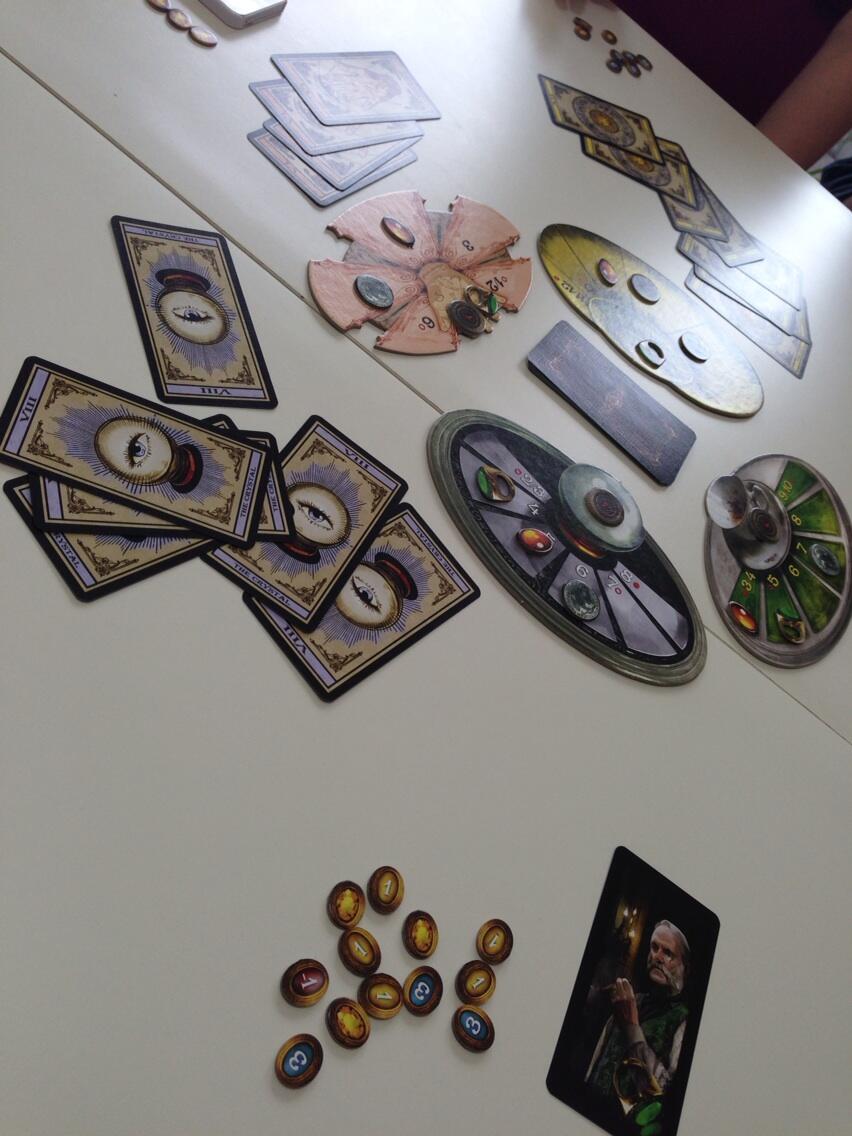 |
| Awesome deduction game |
Game Session and Thoughts: Played with the full 4 this time and it is just as fun. You certainly have to try and keep track of everything so as to force your opponents to have to reposition themselves or suffer the penalties. I realised in this game that with the extra bonuses that you may score if you are in the 2 extremes of each section can sometimes net you more points but those are few and hard to come by. Overall, this game is really dependant on the players and how they play given the cards that they have. Sure the cards you draw can be attributed to randomness but that doesn't stop you from being able to control what you can do as you can chose to give away a lousy hand partially and hope to receive something better. All in all, still a very good game and much liked by everyone so far!
NEW WORLD A CARCASSONNE GAME
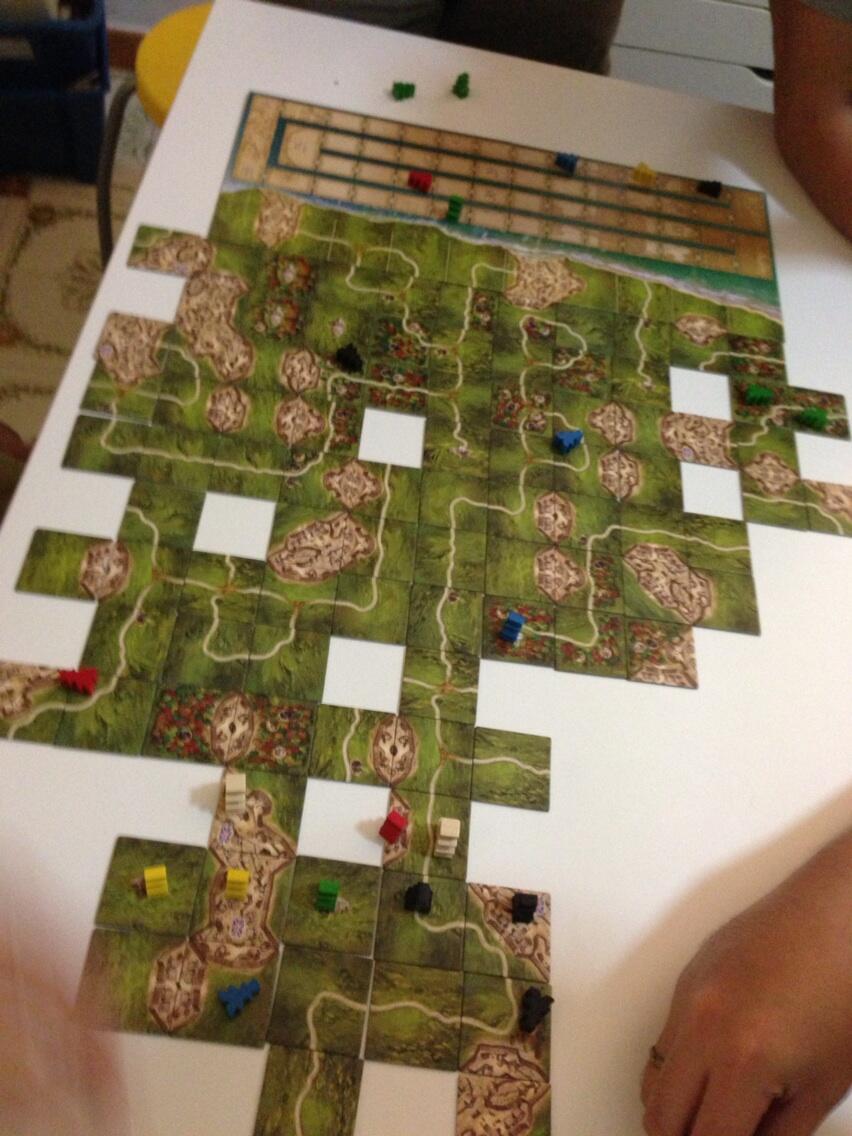 |
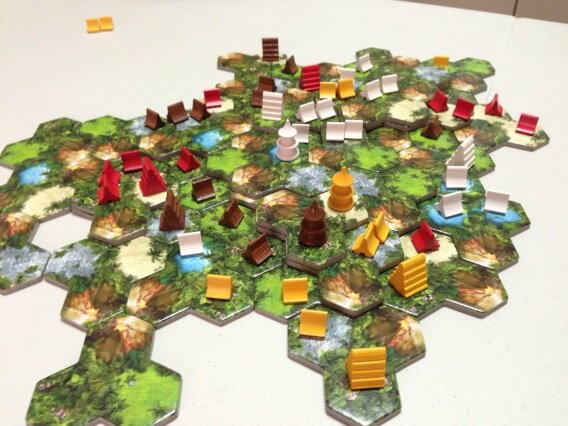
| I think we should all stick to base carcassonne |
Game Session and Thoughts: One of the last game for that night of gaming, we decided to try something that is easy to pick up and did not take a long time. New Word is essentially built on the Carcassonne engine and with just a few small changes. One, there is a column of land where we all start laying tiles from. Two, there are 2 neutral pawns on the board and whenever someone scores, the pawn furthest to behind or nearest to the starting column will move ahead to the next available tile in the adjacent column. If there are any meeples belonging to any player that are yet to be scored but are found to be "offsides", then that meeple will be returned to the player. In essence the neutral pawns are like referees and players, when placing tiles, have to decide if its worth the risk to place a tile back in zones that have been passed over because they offer lucrative scoring but at the risk of someone else scoring before you can and thus making you waste the previous turn. Third, scoring for farms is dependent on the number of animals that exist in the various land areas that are covered by your farmer meeple. Similar to Carcassonne, the player with the most points at the end of the game will win. While there are a few new features, its nothing earth shattering or ground breaking and it plays pretty much like Carcassonne.
Pet Peeves: Art wise while its abit more realistic as compared to the base game, its a bit hard to see the animals in the forested areas.
Conclusion: Having the 2 neutral pawns does cause some of us to play it differently from the base game. I found myself trying to score faster so that I can move the pawns and catch the other players' meeples and thus denying them from scoring. But at its core, its still very carcassonne. I never really liked the multitude of carcassonne expansions because they feel very gimmicky to me. Its abit like all those expansions for Dominion. One or two expansions is fine but after 5 or 8, you get the feeling that they are really trying to squeeze as much mileage as they can from the base game and they are already scrapping the barrel. I mean why don't they just let it be and move on to other games. So for me at least, its a MEH and I don't recommend it.
MIDNIGHT PARTY
 |
| Run run from the ghooooost! |
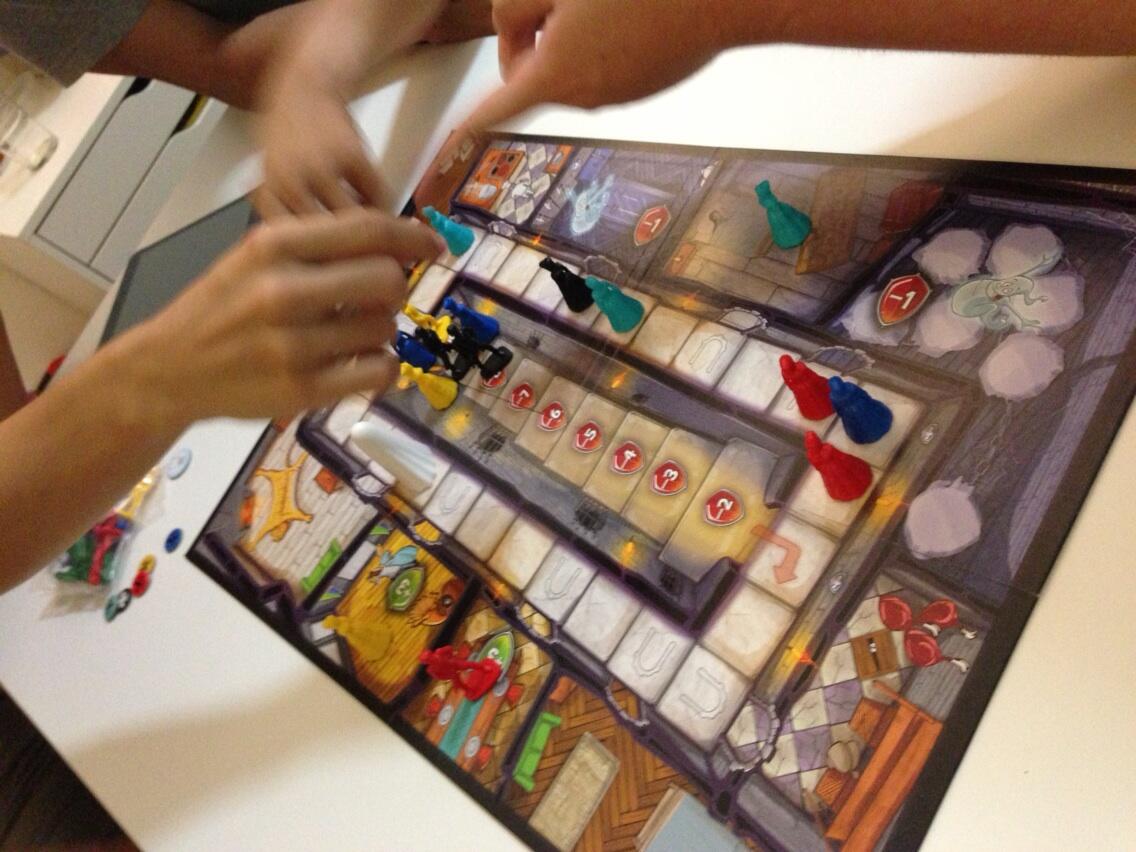
Game Session and Thoughts: A light hearted game where players try to move their pieces around a track to enter empty rooms to hide from a ghost that will be roaming along the halls. At the beginning of your turn, you will roll a die and then move any one of your remaining figures that many spaces. If you roll a ghost on the die, then you move the ghost 3 spaces. Players can only move their figures into a room if the ghost is already on the main track so its like a musical chairs kind of mechanism where players are jostling for positions until the ghost appears. Once all figures are either captured by the ghost or in the rooms, then players will determine the score and keep track. After 4 rounds, the player with the least negative points will win the game.
Pet Peeves: The ghost did not look very scary. In fact it looked downright friendly haha. Players who have been kicked out (because the ghost had captured them) will not have anything else to do other than rolling the die and hoping to move the ghost along. All these are just small little issues and because this is largely a family/kid/party game there is no need to be too harsh on it.
Conclusion: We had a lot of fun moving the ghost along, making 'whooo hooo hooo" noises and catching each other's figures. Playing with 5 players we certainly had a lot of figures (each player had 3) and given that the ghost appears on 2 faces of the die, it came out pretty fast and made short work of those near him. I manage to win with only -14 points so that was cool. Take note that this is definitely a kid friendly family game so Try before you buy if you are looking for a family game. Best with kids.
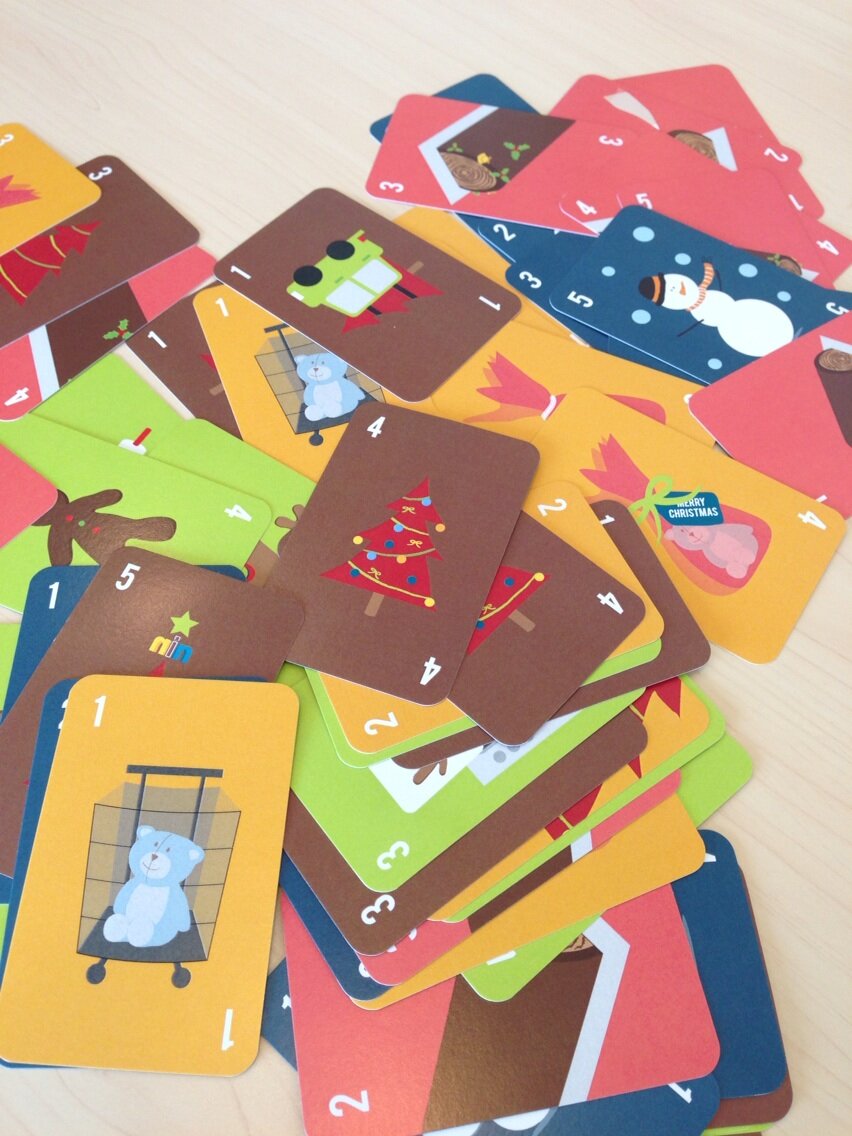
PALASTGEFLUSTER
 |
| Its like a predecessor of Citadels and many others... |
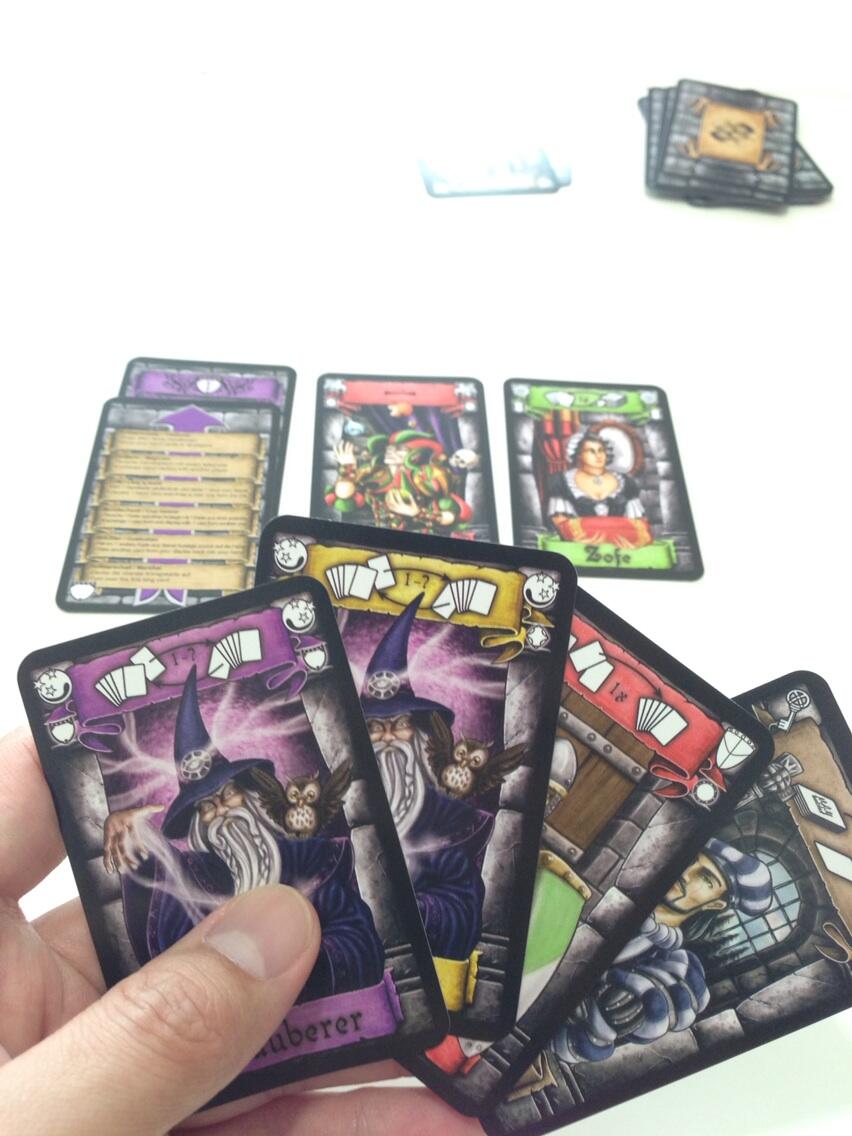
Game Session and Thoughts: I have heard of this game from Garrett's game and geekiness and I decided to grab it as a box filler for my latest order online. This game lasts several rounds until 1 player has reached a certain number of points as determined by the number of players. There are 2 decks to this game. One is the main play deck which consists of a bunch of brown cards and all the cards that belongs to the colors of the players in the game. These cards will have one of 6 characters available in the game. The other is a king deck which, when revealed, determines which character card can be played but will not have any special effect (unless its the Jester card which will indicate that the jester card cannot be played). During your turn, you have to play a card from your hand to the area in front of you. If you have to play a card of a character that already exists in your area, you have caused the end of the round and every OTHER player will score a point. Another way the round can end is if you manage to play 6 different characters into your area. Then you will score the point only. All cards are now collected and reshuffled and each player is dealt 6 cards for a new round. Each character has a certain power which can help you or sabotage others. For example, the Wizard allows you to exchange a number of cards from your hand with another player thus you can pass them cards that will cause them to end the round and everyone else to score a point. The unique part of this game is that how the next player is determined, depending on the card that the previous player has played. If the card is a brown card, then the player who has the least number of cards played in front of them will go next. If this is tied, then the active player chooses who to go. If the card is a colored card, then that player with the same color goes next. The active player can play his/her own color to go next but that depends if he/she is lucky enough to have his own colors, can play them or if it is wise to do so. The symbols aren't that easy to understand but the player aid card (which incidentally is used as an arrow to indicate the number of points you have) has all the description for the powers of the various characters. It is easy to teach though probably needs several plays to better appreciate the nature of the game and how it works. It reminds me a lot of Citadels and I believe several card games nowadays that have characters and powers probably owe some homage to this game. Art work is functional though somewhat dated and its a card game that fits nicely into a small box. Good for traveling.
Pet Peeves: Unfortunately, this game can get draggy. For 5 players, we had to reach 4 points and while that may seem easy to do, it did take some time. At the very least you will need 4 rounds to do so. I am also not too sure about blocking the leader and how well that will function because you are given only 6 cards to play around with and depending on the luck of the draw, you may not have the right cards to block the leader.
Conclusion: We did not manage to finish our game as we had new players joining so we stopped or game short of someone actually winning. I do kinda like it right now given what I have seen but will definitely want to try more to see how it actually works and if it can get too lengthy for the weight of the game it is. Deciding what card to keep and play and which player to go next is quite unique and very intriguing for me. So for now it is ok but with the caveat that I will need more plays to have a final decision. Try before you buy.
TOWER OF BABEL
 |
| Dated when played today... |
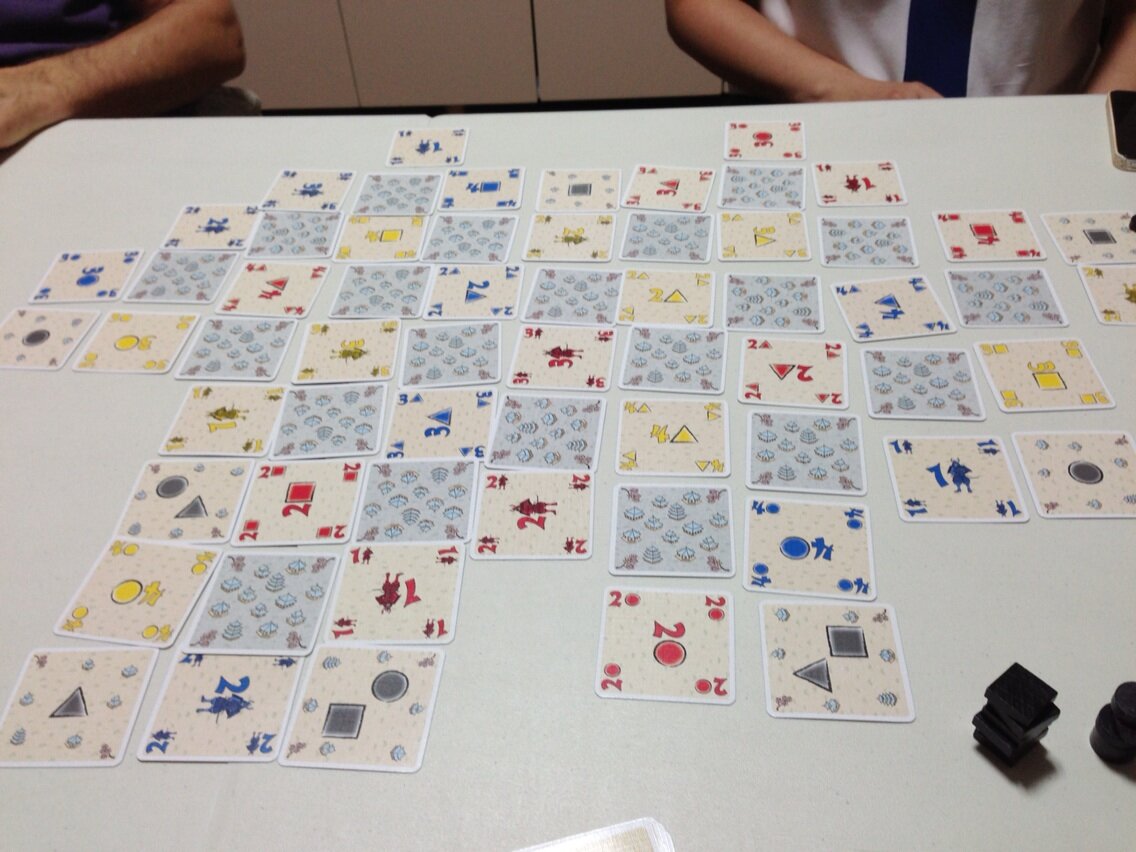
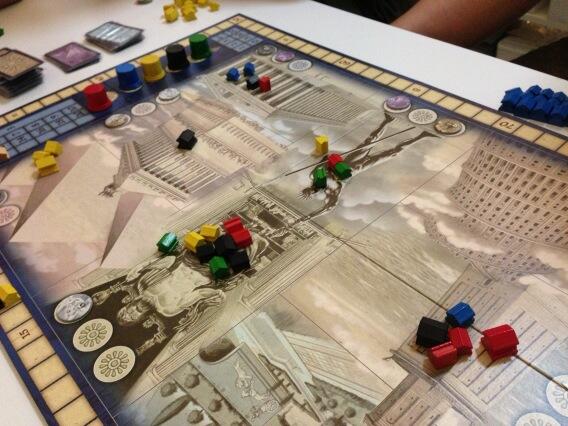
Game Session and Thoughts: A rather old game that someone in our group won and so we decided to give it a go and see whats it like. Basically this is a light-medium area control and set collection type of game. Initial setup, there will be discs placed on spots that represent 7 wonders of the world. Players will be provided with a number of cards initially and a Trade card. During each player's turn, they will choose a spot where there's a disc remaining. This is to indicate their interest to complete the requirements of that disc. Each disc will show a particular object and a number, indicating how many of that type of cards is required to be discarded to complete that disc. Now all other players will pull out a number of cards that they want to offer to the active player. When all have chosen, all will reveal the cards selected. The active player can now choose cards from a number of players to assist him on his task. Owners of the cards that were used to contribute to this disc (including active player) will get to place one of their building tokens onto the wonder. If the active player chose a participating player that has a trade card along with his other cards, then active player will pass that disc to that participating player but get to place his building tokens in place of the participating player's tokens. If a player offered cards but you did not choose that player, then that player will score as many points as cards offered that correspond to the disc's object.
When a wonder has all discs removed, then that wonder is scored. Majority and 2nd runner up will score points and the rest that have contributed will score 3 points. The scoring is incremental which means the next wonder that scores will have more points.
During your turn, you can either choose a disc or pass. If you pass, you will draw a card. At the end of every player's turn, everyone will draw a card. The game ends when all of 1 type of discs has been claimed. Those monuments that were not finished will score a certain number of points and then players reveal the discs they have collected and score points. If you have collected 4 of a kind, then you get to score 30 points which is a lot in the game. The player with the most points will win the game.
Initially we were kinda confused as to why players will bluff (select cards that do not correspond to the disc's object) and we guessed the only reason was to goad the other players into contributing more. Having the trade card in offering is interesting because if the active player does not have enough, he may need to take the trade card OR forgo his turn just to prevent the disc from falling into the wrong hands. It is also very important not to set someone up to complete the monument and score points. Oh you also get a special card if you triggered the scoring of a monument. Most of the time these special cards will provide you with more cards or even give you some points at the end of the game but its hard to come by and in a game at most there will be 7 such cards given out. Art wise its a pretty ok and components wise its a nice and big board but you could probably remake the game using only cards.
When a wonder has all discs removed, then that wonder is scored. Majority and 2nd runner up will score points and the rest that have contributed will score 3 points. The scoring is incremental which means the next wonder that scores will have more points.
During your turn, you can either choose a disc or pass. If you pass, you will draw a card. At the end of every player's turn, everyone will draw a card. The game ends when all of 1 type of discs has been claimed. Those monuments that were not finished will score a certain number of points and then players reveal the discs they have collected and score points. If you have collected 4 of a kind, then you get to score 30 points which is a lot in the game. The player with the most points will win the game.
Initially we were kinda confused as to why players will bluff (select cards that do not correspond to the disc's object) and we guessed the only reason was to goad the other players into contributing more. Having the trade card in offering is interesting because if the active player does not have enough, he may need to take the trade card OR forgo his turn just to prevent the disc from falling into the wrong hands. It is also very important not to set someone up to complete the monument and score points. Oh you also get a special card if you triggered the scoring of a monument. Most of the time these special cards will provide you with more cards or even give you some points at the end of the game but its hard to come by and in a game at most there will be 7 such cards given out. Art wise its a pretty ok and components wise its a nice and big board but you could probably remake the game using only cards.
Pet Peeves: Near the middle and the end of the game, most active players will already have all the cards they need and thus not really require any help from the others and it becomes a matter of offering as much cards as we can to score points. In essence, being prevented from helping can actually score you more points than commencing the scoring for a monument. The player order portion on the board confused us because we failed to see the point of it. I mean there is no need to rotate it but the rules mentioned that when a player has taken his turn, place his token at the back of the line and move the others forward. It because a bit pointless. We may have read some rule wrong on this but doesn't seem like it. Other than that, I couldn't really put my finger on it but most of us felt MEH after playing the game though now that I am writing this, I can't remember why. I guess its the way the game is played and the general mode as we are playing that brought our enjoyment factor of the game down a few notches. It could also be that the mechanisms seems dated given the variety of games that we have nowadays and possibly not as engaging as we thought.
Conclusion: So while it doesn't seem as if we enjoyed the game, now that I am reading my own post, it is quite an ok game. The design has not many flaws and mechanisms, while feels dated, are sound. It probably isn't for our group but may require a few more plays to have a more concrete feeling on why it did not work for our group. Try before you buy.
QUIETVILLE
 |
| It is very quiet.. even with monsters... |
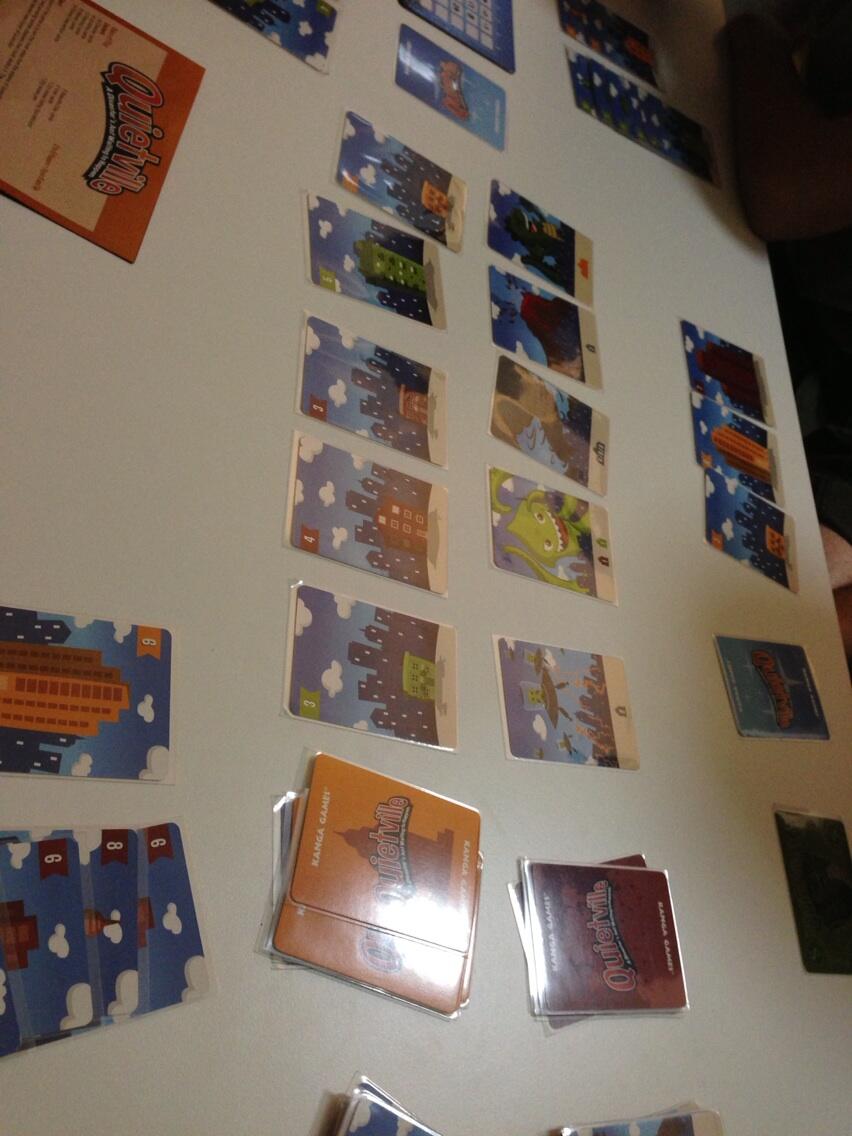
Game Session and Thoughts: A light card game where players are trying to manage the number of buildings in front of them so that they are in the best position to score when any one of the 4 scoring phases card appear in the building deck. There is a set of building cards and disaster cards on the board. During your turn, you can either use 1 money card to purchase a building card, select a disaster cad and apply its effect and obtain a money card or play a Divine Intervention card (if you have any). You can only have a maximum of 2 money cards at 1 time so if you have 2, then you MUST buy a building card or play a Divine Intervention card. Building cards come in 3 colors and a variety of points from 3 to 8. Disaster cards cause you to lose buildings depending on what is indicated on the Disaster card. If you lose 2 buildings, then you will be able to obtain a Divine Intervention card. Otherwise, regardless if you have lost a building or not, you will obtain a money card. Divine intervention cards will usually provide you with special powers like refresh the row of disaster cards etc.
The unique part of the game is when one of 4 scoring cards appear in the building card deck. Whenever a building is taken, that spot is replaced with a new building card. In this way, the scoring cards will appear later on in the game and at the end. Players now choose 1 of 4 scoring types to scoring when a card appear. Players can only choose 1 scoring type per scoring phase for the entire game so players have to plan correctly otherwise they will waste these chances. The 4 types of scoring are: a) score for ALL buildings you currently have, b) score for each of the highest building for each of the colors, c) score for each of the lowest building for each of the colors and d) score all buildings of 1 chosen color. The game ends after the 4th scoring card has been revealed and the player with the most points wins the game.
For this light game, the scoring methods add a surprising depth to it. You have to see if you can hold out and get those buildings that will enable you to perform the scoring that you want. At the same time, you don't want to be caught where you have no choice to purchase but to take a disaster card that will devastate the buildings you already have. Art is quite comic like and nice and everything is clear, easy to teach and easy to play.
The unique part of the game is when one of 4 scoring cards appear in the building card deck. Whenever a building is taken, that spot is replaced with a new building card. In this way, the scoring cards will appear later on in the game and at the end. Players now choose 1 of 4 scoring types to scoring when a card appear. Players can only choose 1 scoring type per scoring phase for the entire game so players have to plan correctly otherwise they will waste these chances. The 4 types of scoring are: a) score for ALL buildings you currently have, b) score for each of the highest building for each of the colors, c) score for each of the lowest building for each of the colors and d) score all buildings of 1 chosen color. The game ends after the 4th scoring card has been revealed and the player with the most points wins the game.
For this light game, the scoring methods add a surprising depth to it. You have to see if you can hold out and get those buildings that will enable you to perform the scoring that you want. At the same time, you don't want to be caught where you have no choice to purchase but to take a disaster card that will devastate the buildings you already have. Art is quite comic like and nice and everything is clear, easy to teach and easy to play.
Pet Peeves: I think the most irritating thing will have to be the luck of the draw. If you are very unlucky, during your turn you may end up with the worse types of disasters (where you will lose a lot of buildings) or with the low scoring buildings or if you have a divine intervention card that doesn't help you at all. Otherwise, there is very little else that is wrong with the game.
Conclusion: So a light game that is easy to play and surprisingly fun with a bit of strategic planning but more tactical than anything. Whenever we saw a chance to take a disaster card that did not sabotage ourselves too much, we went for it. We did not really focus too much on the Divine Intervention cards as their powers while helpful aren't all that game changing. I did not win though but I still had fun. Try before you buy.
CITE
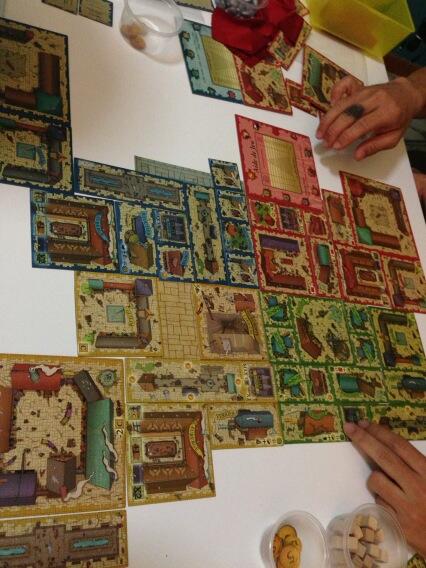
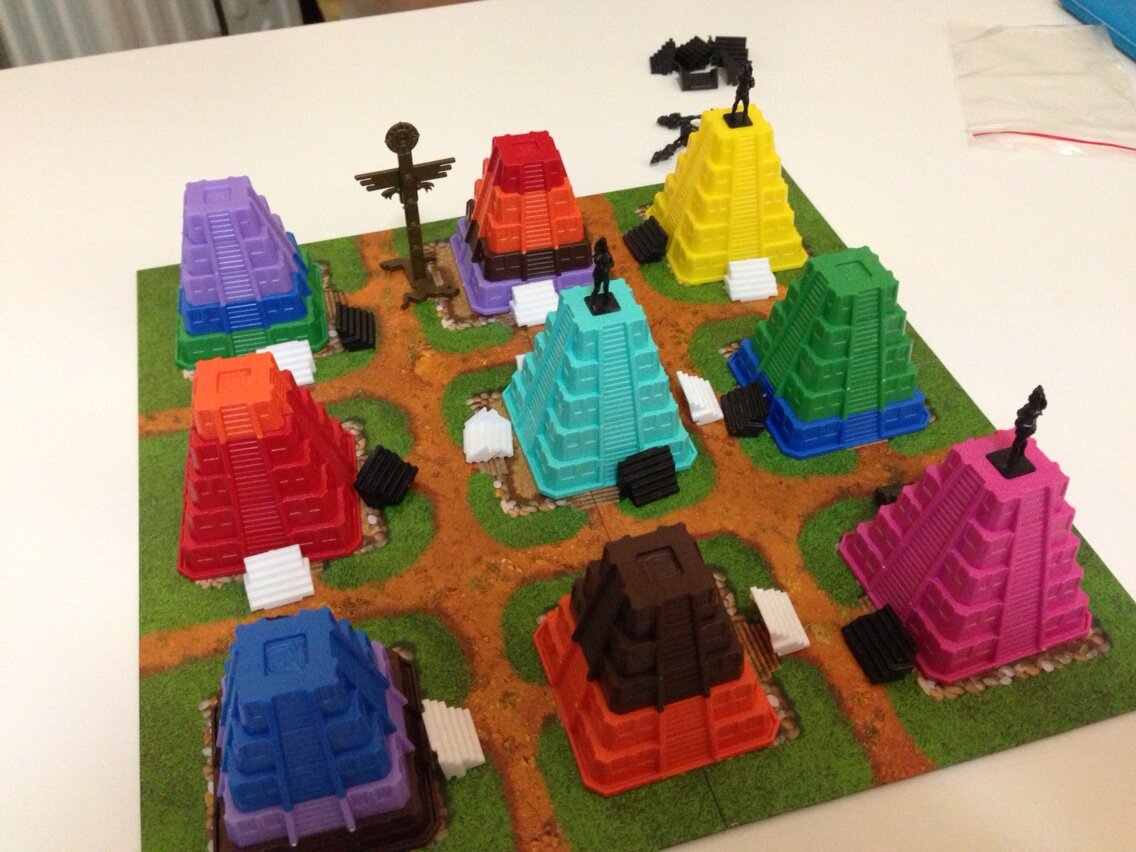
Game Session and Thoughts: A light-medium, negotiation heavy, tile laying game similar to Princes of Florence. Each player has a set of similar buildings which occupy 1-9 spaces. Your objective is to place/build as many of these buildings as you can within the 7 rounds. The player who has built the most spaces of buildings will win the game. At the start, players are allowed to place up to 7 spaces of buildings. Each player will have a unique resource which only they have (i.e. Yellow has the rock, Red has the cloth) and thus the negotiation is required so that resources from other players can be traded to create secondary elements. The interesting part of the game is how you can build the buildings. The more variety of materials you have, the less of them you need and the more spaces you can build. For example, if you only have 1 type of material, you will need 10 of them to be able to build 1 space. If you have 5 for example, you just need 1 of each to be able to do the same. To be able to create more materials you will need to build your secondary buildings, get the other base material from another player and then be able to build it OR trade another player who has built it. Game play essentially is income (production), negotiation (exchange of goods) and then build. Game ends after 7 rounds or whomever has built all their pieces and the player with the most built squares will win the game. As you can already tell, this game relies a LOT of negotiation although another player managed to build with minimal negotiation and exchange of goods. He also forced his basic material to be rare and hard to come by. In addition, you have to negotiation because of the close proximity of your buildings. Right in the beginning there is a game board where you can place your starting buildings which is the only area where each player's buildings can be adjacent to each other and provide additional benefits to each other. Gameplay can be pretty fast though unless negotiations bog down and cause a stalemate in the game. Components wise are rather good. In fact, they can be considered over produced! The stone are really small stone pebbles and the cloth is nice rich red cloth squares. But they could have done with red cubes and it would have been easier to handle and manage.
Pet Peeves: Its kinda odd but the playing area will extend beyond the main board. Since you are pretty much given free reign (except that the new building must touch an existing building), you can expand if you want all over your corner of the table. As mentioned above, the materials seems to be over produced. The red player had problem trying to count the number of cloth because, since this was a new set, the clothes were not separated before. Though if they used the cloth same as Marrakech that might have been easier to manage. You need like a bowl or something to keep the amount of material which you may have been able to produced given that the components are not all the same sizes. You may also need to supplement with your own bits as it did not seem to be enough. The game owner used lego bits to supplement what was provided. There is a building that functions like a Bank. You can place up to 3 materials on it and then get some returns. However since the bank building piece is so small, its a bit impractical to place them onto the building. Lastly, the building's functionalities are written on the reverse side of the building but when you build them onto your area, they look better the picture side up so kind of prevents us from referring to their functions once placed on the play area.
Conclusion: I am beginning to shun from pure negotiation games because well, I seem to suck at negotiations :P Some negotiation is fine but if its pure negotiation then I will approach with some apprehension. That being said, there is a lot of chance for "mistakes" in this game because everything is concurrent (the negotiation, exchange of goods and building), people can make mistakes accidentally and kinda takes away from the "pureness" of a win. Not saying that I won of course lol it was all I could do to not be last (Can't remember if I was last ....). So this game is not for me. Might be for you though so verdict is Try before you buy.
SHEEPLAND
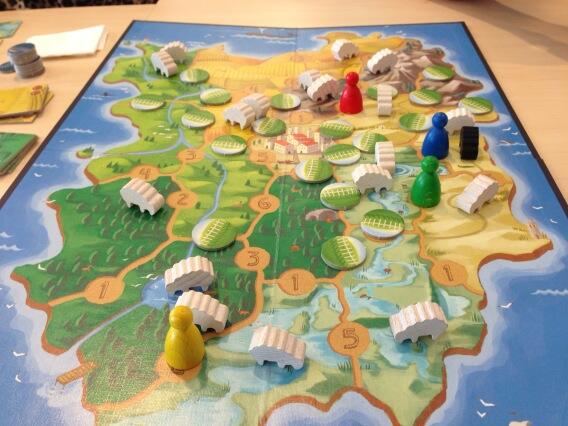
Game Session and Thoughts: Avery simple stocks and shares game that is masked with cute sheepples. Yes I said stocks and shares. You have a board with different regions (mountain, plans, swamp, forrest and grassland) and at the start there will be a sheep in every region. Each player starts with a secret land tile randomly assigned at the start of the game. During your turn, you will first roll a die to see where the black sheep may escape to (Black sheep counts as 2 white sheep). Then you can do 3 actions, out of which, 1 of them must be to move your Shepard. If you perform 2 of the same actions, then you have to move the Shepard inbetween those 2 actions (i.e. Action, Move, Action). Actions are moving a sheep (from one region to another through your Shepard), purchasing a land tile (either of the 2 land tiles that are adjacent to your Shepard) or moving your Shepard. That is it. The game ends when a certain number of fences have been placed on the board and everyone plays till the end of that current round. Players then count up the points they have (number of sheeps in that land area multiply with the number of that land's tiles you have) and the winner is the one with the most points.
So essentially its a stocks and shares game because you are trying to amass a number of tiles (you can see these as shares) while trying to manipulate the sheeps into those land areas (price of shares). It is easy to teach and easy to play however it is quite a light game. Components are rather good looking and of course, the sheepples are very cute. It is interesting to note that most people are focusing a lot on the black sheep as it gets moved around but after a while when the black sheep gets cornered and stuck, then players will start to focusing on other areas. Diversity of the stocks (land tiles) is key here as you don't want to get trapped into only being able to buy those expensive tiles as money is VP at the end of the game and the initial tiles are free or very cheap.
Pet Peeves: The board had some serious warping issues which is unfortunate. But other than that, there is not much to complain for this rather simple game.
Conclusion: It is a very light game. That being said, there could be chances for screwage because you can often tell what an opponent is going for and move his sheeps out of the land areas that he wants. However to do that your Shepard has to already be in position or stalking his Shepard very closely. As this is probably a family friendly game, I don't think there's a lot of in built opportunities for screwing around with other players. There are opportunities for interaction but only if the Shepards are close together. So all in all, this is a light game and doesn't provide a lot of depth for me and I was glad to be able to try it but will not be making a purchase. Try before you buy.