Recently played

Monday, April 8, 2013

Coup, Kings of Air and Steam, Divinare, New World, Midnight Party, Palastgefluster, Tower of Babel, Quietville, Cite, Sheepland

And another week has past and 1 more week to our next episode! I hope I will be able to start a few feature on our podcast. This week, there aren't any new games (to me) that I would like to specially point out as being excellent and those that are above average are Quietville and Palastgefluster. Lets get on with the reviews! 

COUP
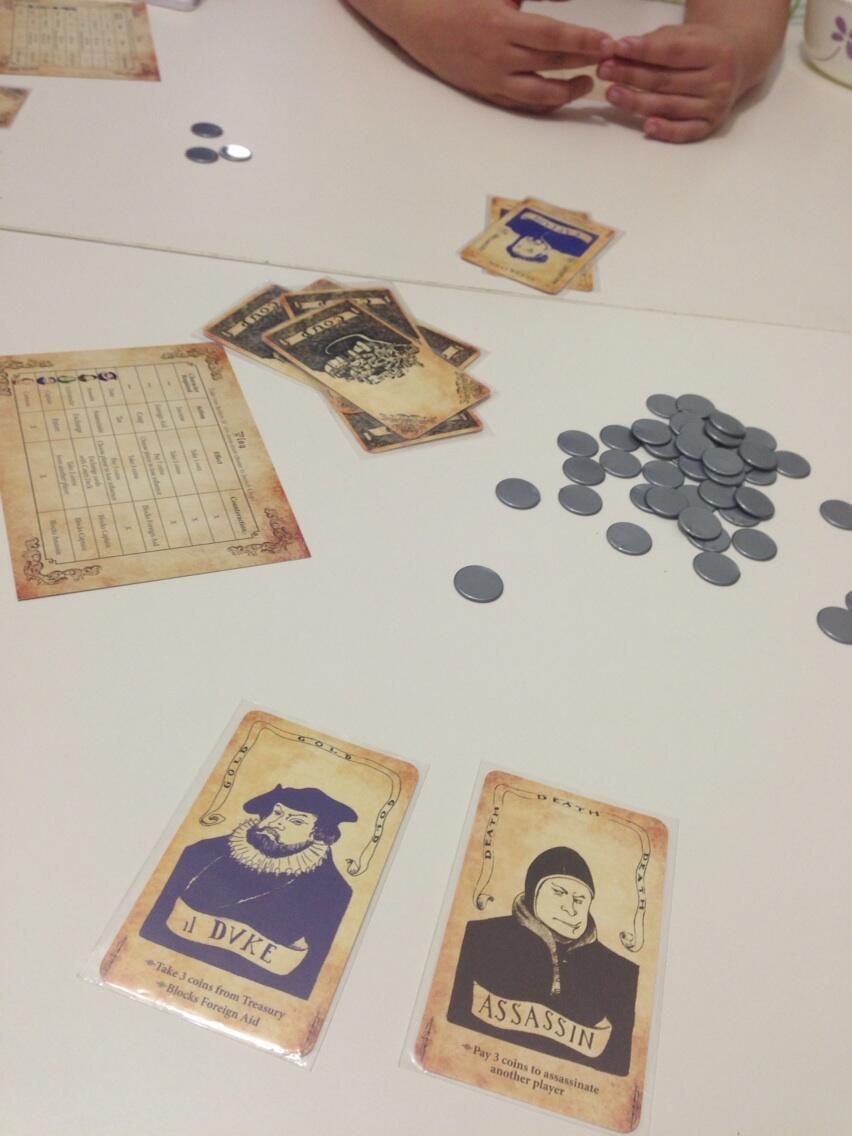
Sigh i never seem to win at this...
Game Session and Thoughts:  Brought this out for a quick 6 player game. Nothing new here to add about the game that you don't already know except we had 3 new players to the group and one of them cannot lie lol. I also have difficulty playing this game because the 2 cards that I have really compels me to use their powers only and nothing else. I wonder if its how I have been playing boardgames (because most games you are only allowed to use what you have and follow the rules) or how I am. So while I am not super psyched and love this game like how some others do, I think I will still be keeping the game and take it out from time to time. Its a nice filler and plays up to 6. Not many games I have can do that nowadays.


KINGS OF AIR AND STEAM

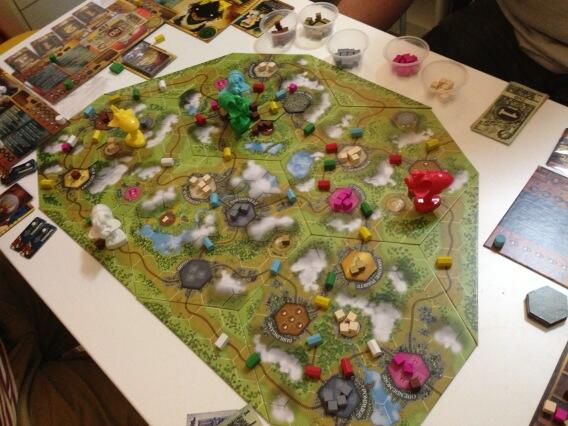
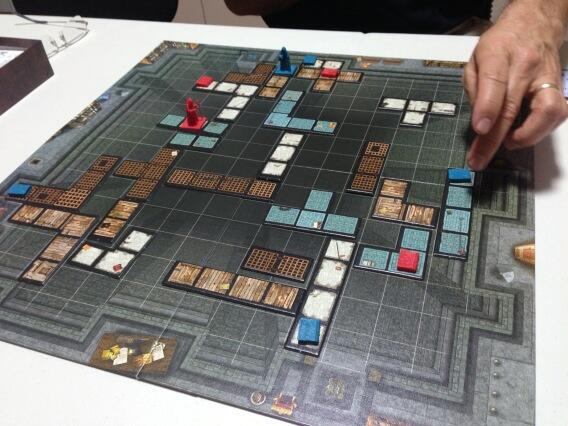
5 player game! Smaller map.

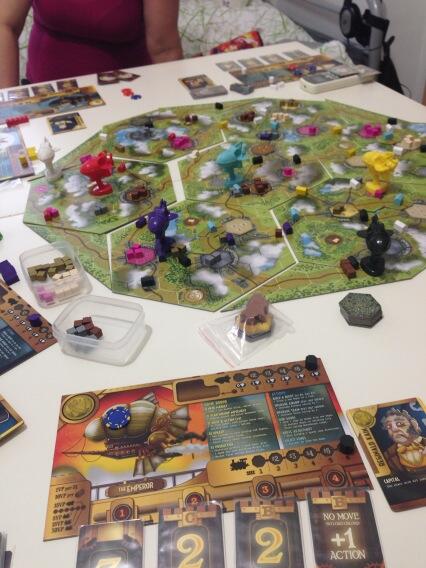
6 player game. All map tiles used!
Game Session and Thoughts: Ah this is a Kickstarter-ed game and after watching the reviews from Joel Eddy, I was eager to grab myself a copy and see how it works with my groups. Gameplay wise its pretty straight forward. Players will have an airship and are flying around to the various factories on the board to pick up goods. Then they fly the airships to their own depots to drop off the goods and subsequently have their goods delivered to respective cities to earn money. After 5 rounds, whoever has the most VPs (in terms of money, built depots, upgraded airship and trains) will win the game. Simple right?
At the start, there will be a market phase where 3 tiles are revealed and the prices of the goods corresponding to the revealed tiles are increased. Next, players simultaneously decide from a deck of movement cards which 4 cards they will perform this round and place these cards faced down in 4 slots. This is very similar to Roborally. Once all players have committed their moves, all players will reveal the first card and depending on the letters on each card, move in alphabetical order. Move cards will usually have the number of spaces your airship can move and you must move all the steps. After you have moved, you can load and unload goods and then you can perform an action. Actions include building a depot, shipping goods (from Depot to City), upgrading your airship, upgrading your train (there's this invisible train that runs from your depots to other depots or cities), getting $3 from the bank or flight adjustment (move your airship 1 space). So play will continue this way until all 4 move+actions are done and then players will need to pay upkeep ($1 for every good in their cargo hold and depot) and then factories will produce (At least 1 per round). That will be the end of the round.
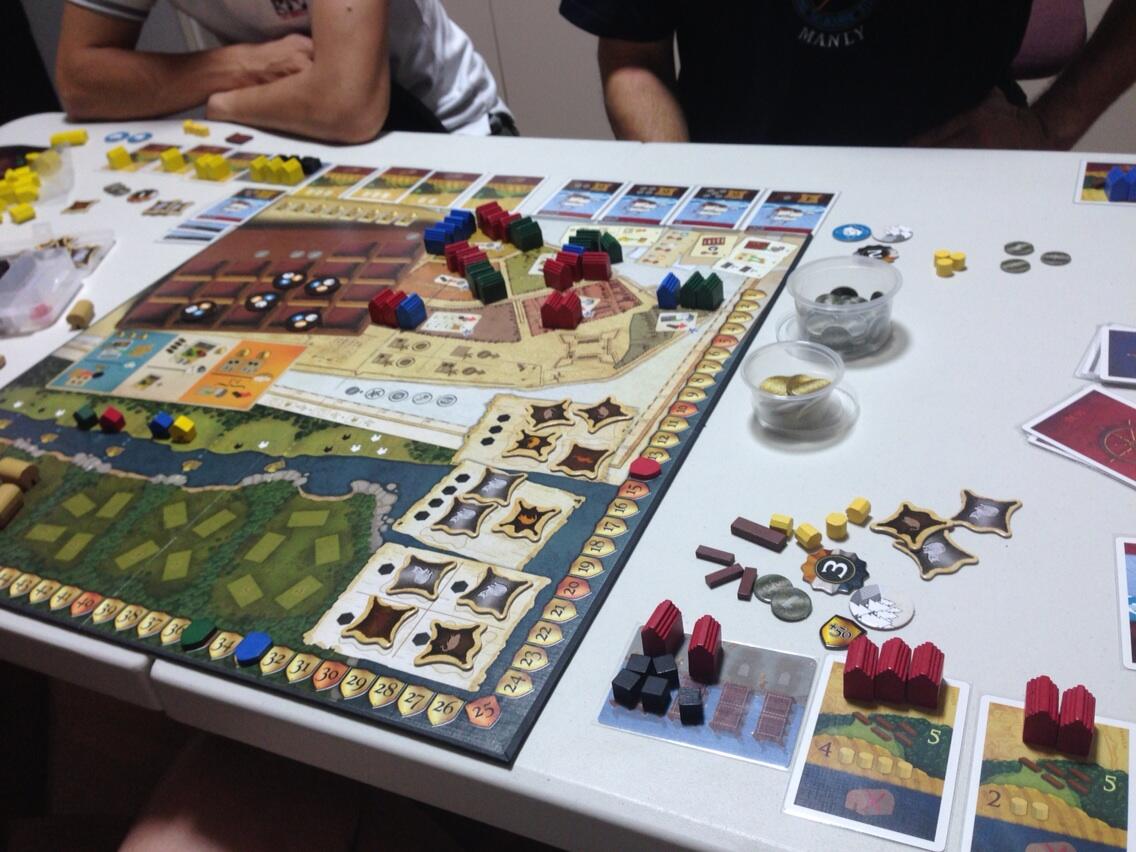
Now if you have seen the pictures, the components look very good. Goods are cubes which are ok, depots are little wooden houses which are also ok and the airships are nice big plastic airships and nicely detailed. The artwork is also very nice and every ship has a unique design and signature. Each player also has a unique character that they can choose from. The board itself when assembled really looked surreal as one player put it. The clouds floating across the cities and our airships flying around the board does make it feel all very thematic. Gameplay wise, its simple as I have already described above and easy to play. Teaching it though there are some bits that will require playing it one round to understand the concepts better. The paper money has a nice design on it though its paper which I did not prefer. So all in all, it played quite ok and is very straight forward. Fly around, pick up goods, drop off goods, deliver them, sell get money and upgrade your airship, trains and build depots. 
Pet Peeves: The airships, while very nice and big, are just too big for the board. Their stands need to share space with the depots and goods on the ground and even worse, another airship if they are both in the same space. Its all very nice to look at and handle and adds a lot thematically but practically its horrible. Its also not easy to locate all the factories when you are repopulating the cubes at the end of a round. Paper money is something that I frown upon but having those small poker chips that I have does make it easier to play and handle. This game also needs a rather large space to play on.
Conclusion: So all in all, this is a pretty ok game. Straight forward pick up and deliver game and I would consider this light-medium weight. Not much interaction between players except for rushing to grab the goods before another player does. Unless another player grabs the nasty character that steals $3 whenever his ship flies through another. Though in my 2nd game, the player playing that character never stole ANY money and she won handily. Problem for me though was there was nothing new to me about this game that grabbed my attention and made me want to hold on to this and play a lot more times. There is certainly replayability with the different characters and the components are attractive and nice and all that but the mechanisms are the same as many other games and thus did not excite me much. Still, its a Try before you buy.


DIVINARE
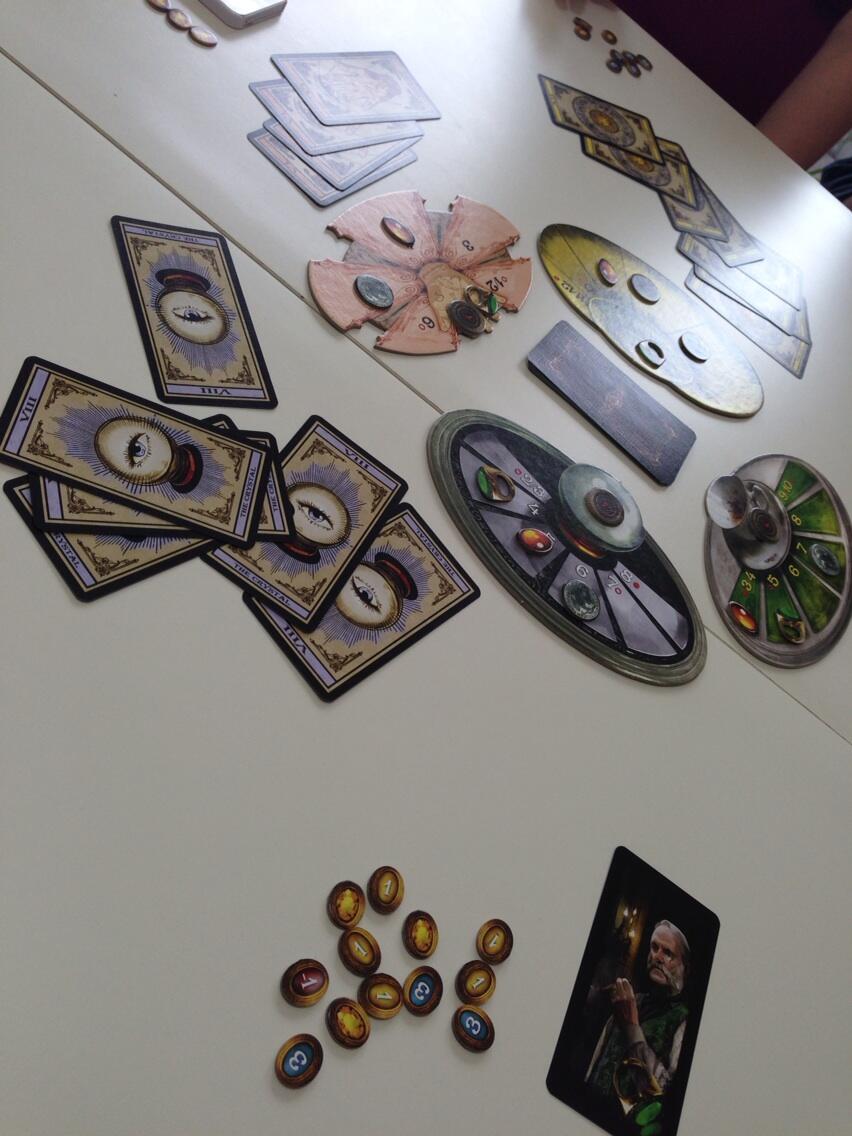
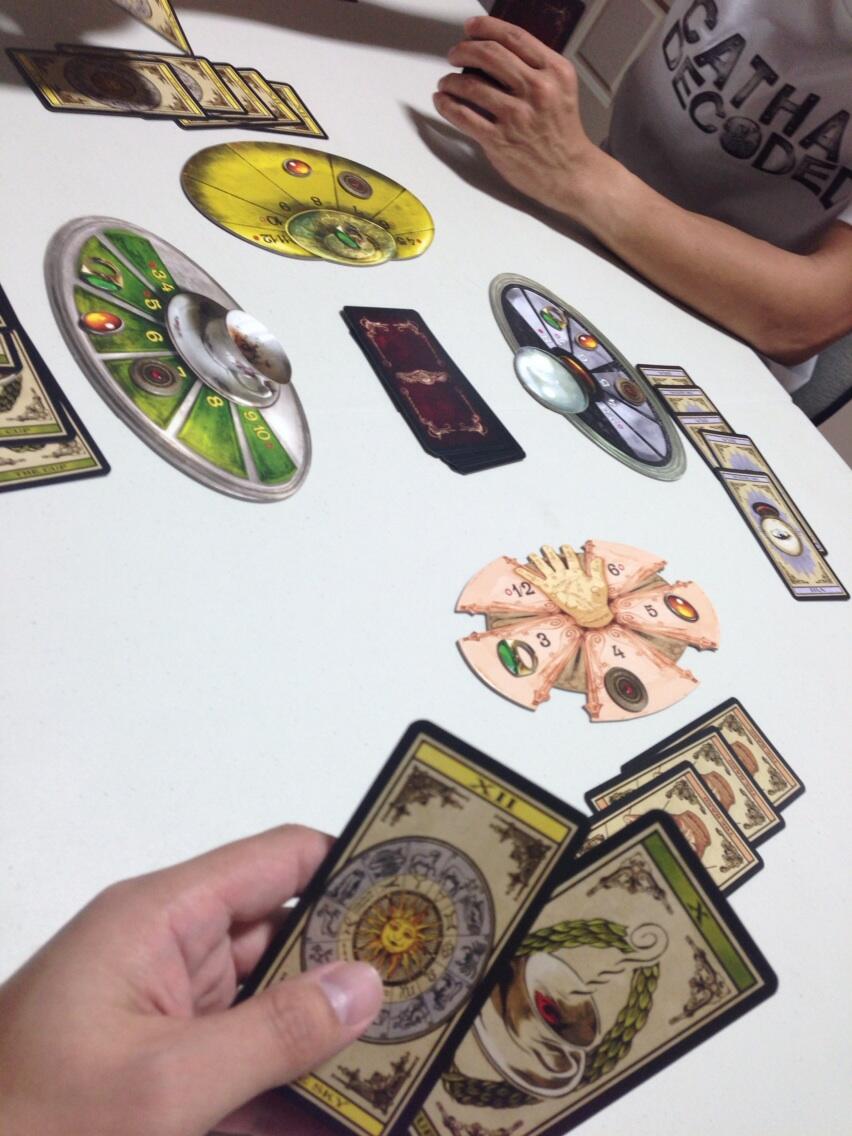
Awesome deduction game
Game Session and Thoughts: Played with the full 4 this time and it is just as fun. You certainly have to try and keep track of everything so as to force your opponents to have to reposition themselves or suffer the penalties. I realised in this game that with the extra bonuses that you may score if you are in the 2 extremes of each section can sometimes net you more points but those are few and hard to come by. Overall, this game is really dependant on the players and how they play given the cards that they have. Sure the cards you draw can be attributed to randomness but that doesn't stop you from being able to control what you can do as you can chose to give away a lousy hand partially and hope to receive something better. All in all, still a very good game and much liked by everyone so far! 


NEW WORLD A CARCASSONNE GAME
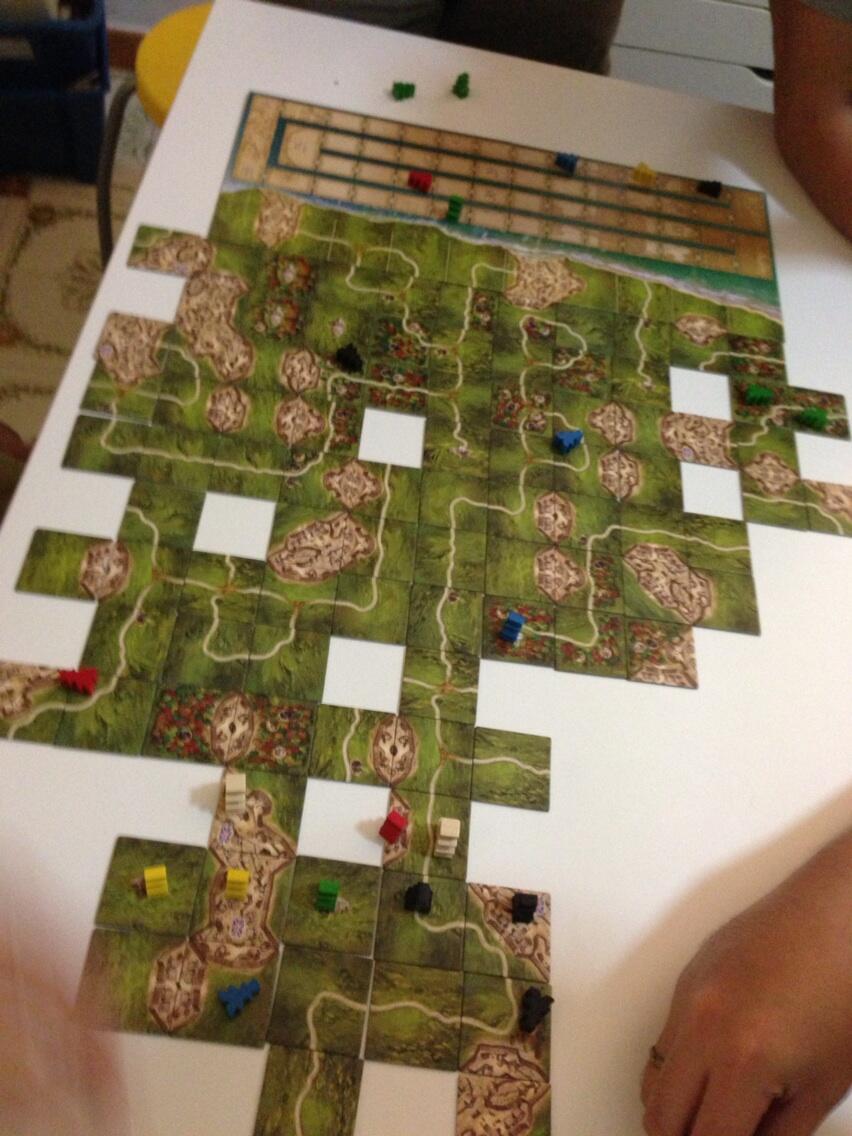
I think we should all stick to base carcassonne

Game Session and Thoughts: One of the last game for that night of gaming, we decided to try something that is easy to pick up and did not take a long time. New Word is essentially built on the Carcassonne engine and with just a few small changes. One, there is a column of land where we all start laying tiles from. Two, there are 2 neutral pawns on the board and whenever someone scores, the pawn furthest to behind or nearest to the starting column will move ahead to the next available tile in the adjacent column. If there are any meeples belonging to any player that are yet to be scored but are found to be "offsides", then that meeple will be returned to the player. In essence the neutral pawns are like referees and players, when placing tiles, have to decide if its worth the risk to place a tile back in zones that have been passed over because they offer lucrative scoring but at the risk of someone else scoring before you can and thus making you waste the previous turn. Third, scoring for farms is dependent on the number of animals that exist in the various land areas that are covered by your farmer meeple. Similar to Carcassonne, the player with the most points at the end of the game will win. While there are a few new features, its nothing earth shattering or ground breaking and it plays pretty much like Carcassonne.
Pet Peeves: Art wise while its abit more realistic as compared to the base game, its a bit hard to see the animals in the forested areas.
Conclusion: Having the 2 neutral pawns does cause some of us to play it differently from the base game. I found myself trying to score faster so that I can move the pawns and catch the other players' meeples and thus denying them from scoring. But at its core, its still very carcassonne. I never really liked the multitude of carcassonne expansions because they feel very gimmicky to me. Its abit like all those expansions for Dominion. One or two expansions is fine but after 5 or 8, you get the feeling that they are really trying to squeeze as much mileage as they can from the base game and they are already scrapping the barrel. I mean why don't they just let it be and move on to other games. So for me at least, its a MEH and I don't recommend it.


MIDNIGHT PARTY
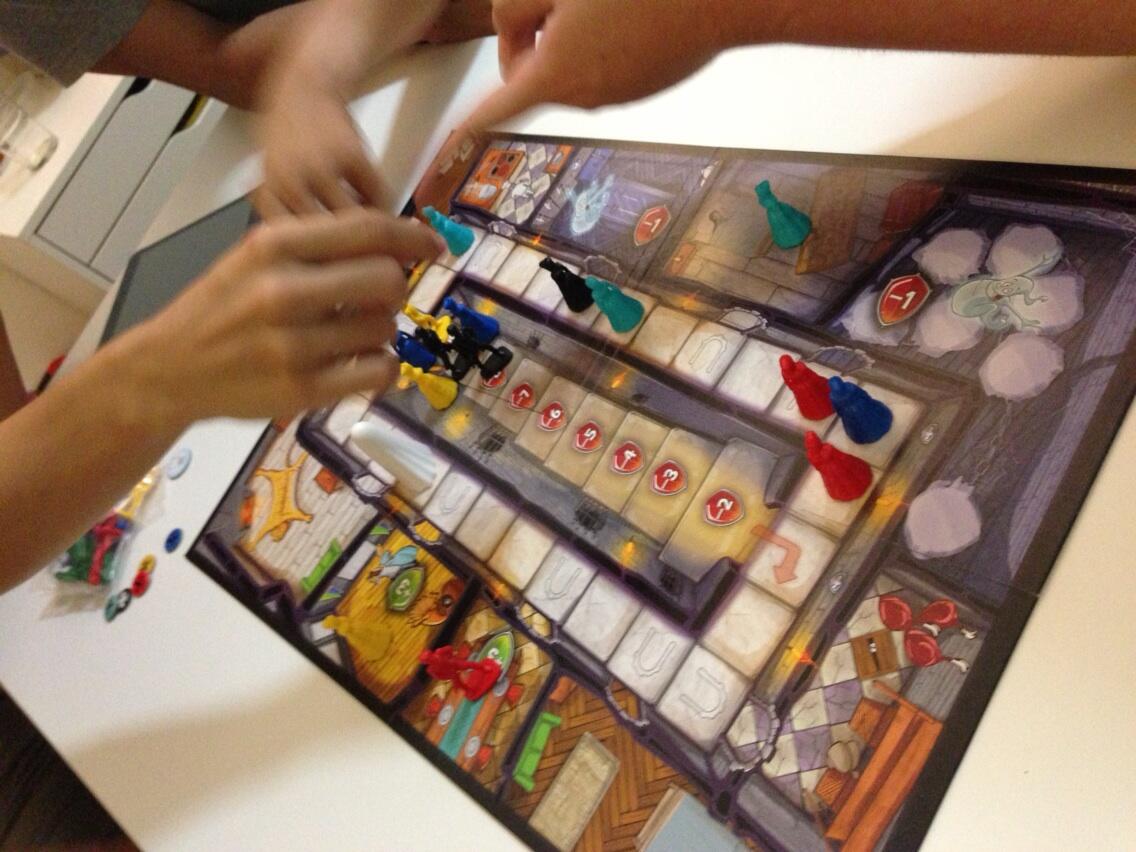
Run run from the ghooooost! 
Game Session and Thoughts: A light hearted game where players try to move their pieces around a track to enter empty rooms to hide from a ghost that will be roaming along the halls. At the beginning of your turn, you will roll a die and then move any one of your remaining figures that many spaces. If you roll a ghost on the die, then you move the ghost 3 spaces. Players can only move their figures into a room if the ghost is already on the main track so its like a musical chairs kind of mechanism where players are jostling for positions until the ghost appears. Once all figures are either captured by the ghost or in the rooms, then players will determine the score and keep track. After 4 rounds, the player with the least negative points will win the game.
Pet Peeves: The ghost did not look very scary. In fact it looked downright friendly haha. Players who have been kicked out (because the ghost had captured them) will not have anything else to do other than rolling the die and hoping to move the ghost along. All these are just small little issues and because this is largely a family/kid/party game there is no need to be too harsh on it.
Conclusion: We had a lot of fun moving the ghost along, making 'whooo hooo hooo" noises and catching each other's figures. Playing with 5 players we certainly had a lot of figures (each player had 3) and given that the ghost appears on 2 faces of the die, it came out pretty fast and made short work of those near him. I manage to win with only -14 points so that was cool. Take note that this is definitely a kid friendly family game so Try before you buy if you are looking for a family game. Best with kids.


PALASTGEFLUSTER
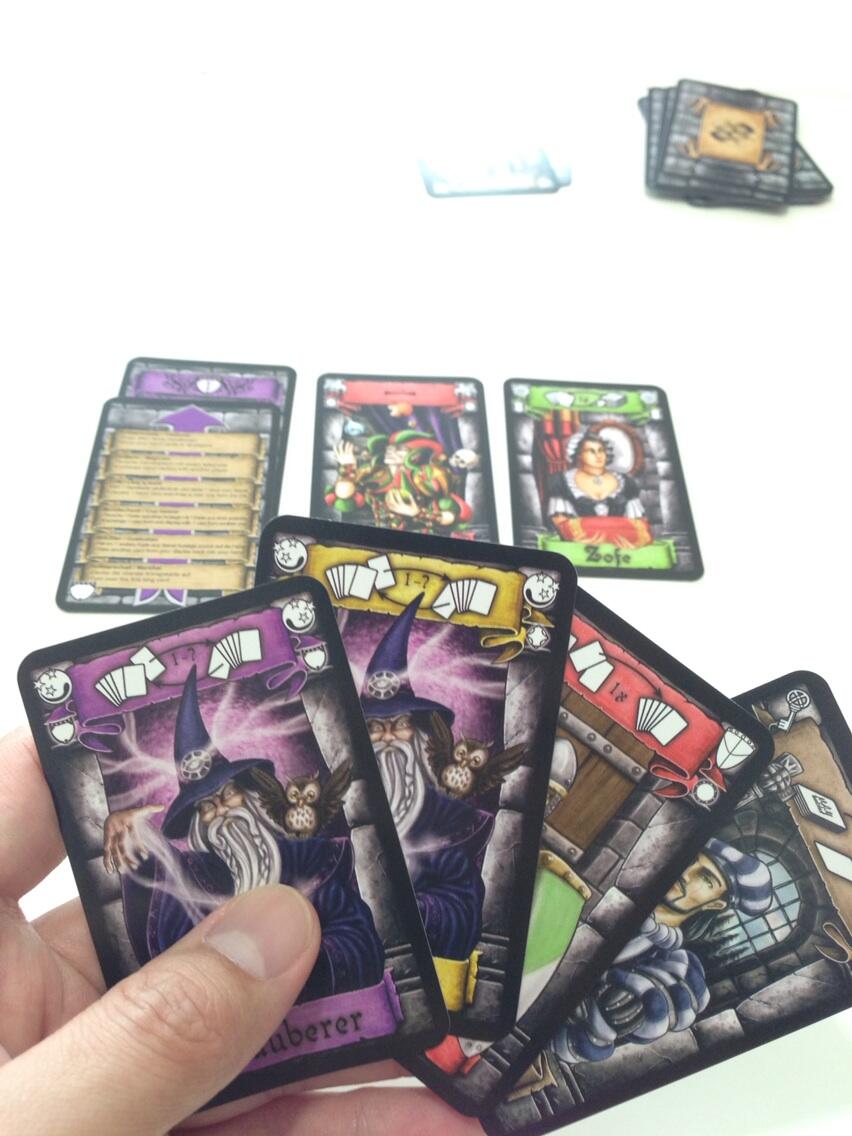
Its like a predecessor of Citadels and many others...

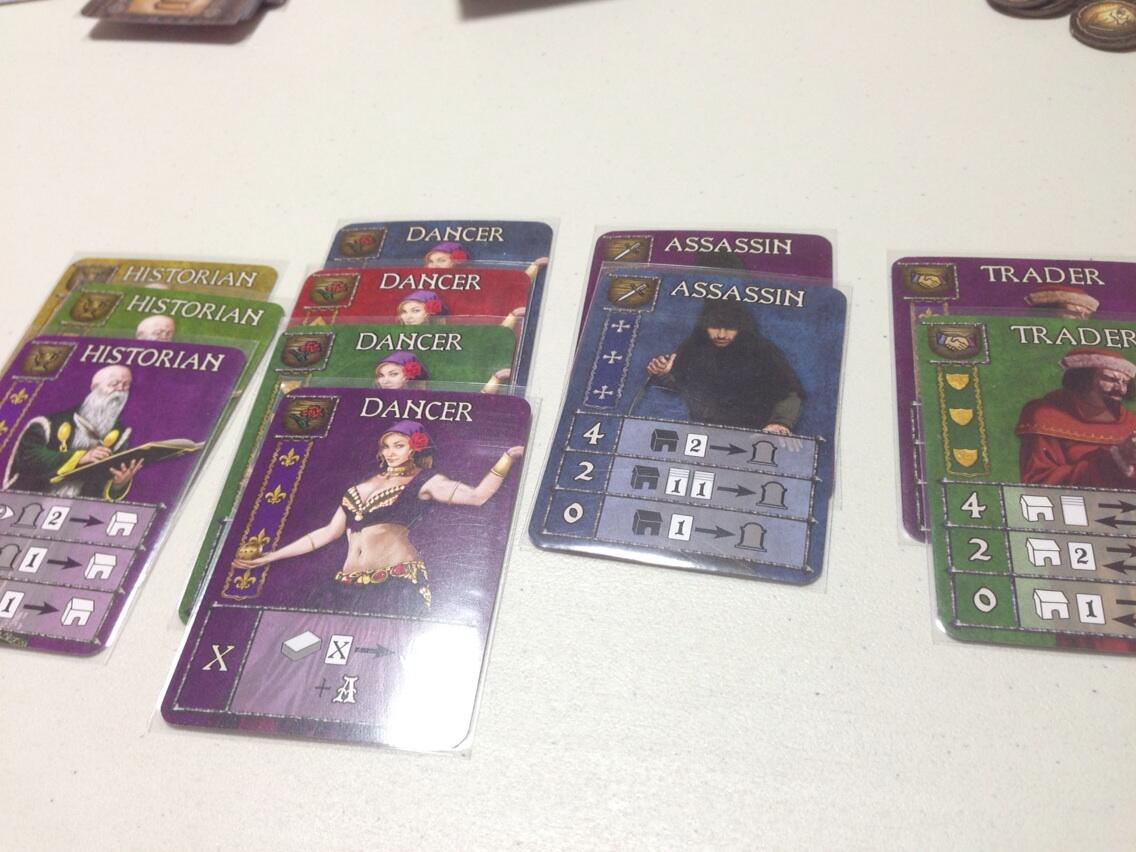
Game Session and Thoughts:  I have heard of this game from Garrett's game and geekiness and I decided to grab it as a box filler for my latest order online. This game lasts several rounds until 1 player has reached a certain number of points as determined by the number of players. There are 2 decks to this game. One is the main play deck which consists of a bunch of brown cards and all the cards that belongs to the colors of the players in the game. These cards will have one of 6 characters available in the game. The other is a king deck which, when revealed, determines which character card can be played but will not have any special effect (unless its the Jester card which will indicate that the jester card cannot be played). During your turn, you have to play a card from your hand to the area in front of you. If you have to play a card of a character that already exists in your area, you have caused the end of the round and every OTHER player will score a point. Another way the round can end is if you manage to play 6 different characters into your area. Then you will score the point only. All cards are now collected and reshuffled and each player is dealt 6 cards for a new round. Each character has a certain power which can help you or sabotage others. For example, the Wizard allows you to exchange a number of cards from your hand with another player thus you can pass them cards that will cause them to end the round and everyone else to score a point. The unique part of this game is that how the next player is determined, depending on the card that the previous player has played. If the card is a brown card, then the player who has the least number of cards played in front of them will go next. If this is tied, then the active player chooses who to go. If the card is a colored card, then that player with the same color goes next. The active player can play his/her own color to go next but that depends if he/she is lucky enough to have his own colors, can play them or if it is wise to do so. The symbols aren't that easy to understand but the player aid card (which incidentally is used as an arrow to indicate the number of points you have) has all the description for the powers of the various characters. It is easy to teach though probably needs several plays to better appreciate the nature of the game and how it works. It reminds me a lot of Citadels and I believe several card games nowadays that have characters and powers probably owe some homage to this game. Art work is functional though somewhat dated and its a card game that fits nicely into a small box. Good for traveling.
Pet Peeves: Unfortunately, this game can get draggy. For 5 players, we had to reach 4 points and while that may seem easy to do, it did take some time. At the very least you will need 4 rounds to do so. I am also not too sure about blocking the leader and how well that will function because you are given only 6 cards to play around with and depending on the luck of the draw, you may not have the right cards to block the leader.
Conclusion: We did not manage to finish our game as we had new players joining so we stopped or game short of someone actually winning. I do kinda like it right now given what I have seen but will definitely want to try more to see how it actually works and if it can get too lengthy for the weight of the game it is. Deciding what card to keep and play and which player to go next is quite unique and very intriguing for me. So for now it is ok but with the caveat that I will need more plays to have a final decision. Try before you buy.


TOWER OF BABEL
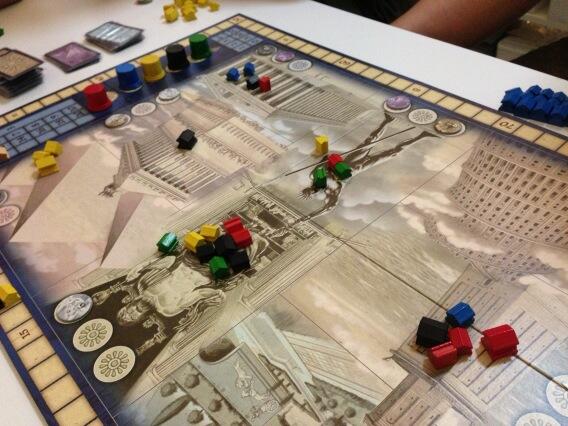
Dated when played today...
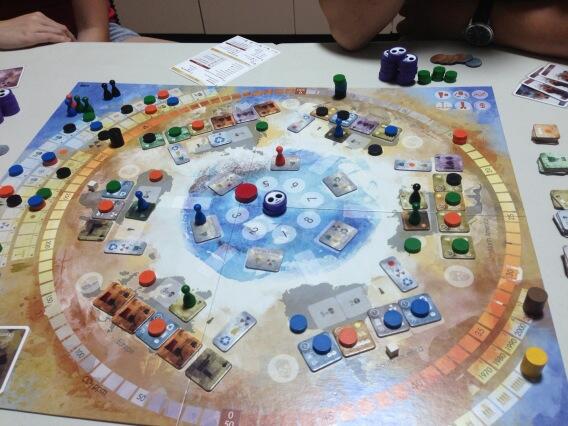
Game Session and Thoughts: A rather old game that someone in our group won and so we decided to give it a go and see whats it like. Basically this is a light-medium area control and set collection type of game. Initial setup, there will be discs placed on spots that represent 7 wonders of the world. Players will be provided with a number of cards initially and a Trade card. During each player's turn, they will choose a spot where there's a disc remaining. This is to indicate their interest to complete the requirements of that disc. Each disc will show a particular object and a number, indicating how many of that type of cards is required to be discarded to complete that disc. Now all other players will pull out a number of cards that they want to offer to the active player. When all have chosen, all will reveal the cards selected. The active player can now choose cards from a number of players to assist him on his task. Owners of the cards that were used to contribute to this disc (including active player) will get to place one of their building tokens onto the wonder. If the active player chose a participating player that has a trade card along with his other cards, then active player will pass that disc to that participating player but get to place his building tokens in place of the participating player's tokens.  If a player offered cards but you did not choose that player, then that player will score as many points as cards offered that correspond to the disc's object.

When a wonder has all discs removed, then that wonder is scored. Majority and 2nd runner up will score points and the rest that have contributed will score 3 points. The scoring is incremental which means the next wonder that scores will have more points.
During your turn, you can either choose a disc or pass. If you pass, you will draw a card. At the end of every player's turn, everyone will draw a card. The game ends when all of 1 type of discs has been claimed. Those monuments that were not finished will score a certain number of points and then players reveal the discs they have collected and score points. If you have collected 4 of a kind, then you get to score 30 points which is a lot in the game. The player with the most points will win the game.
Initially we were kinda confused as to why players will bluff  (select cards that do not correspond to the disc's object) and we guessed the only reason was to goad the other players into contributing more. Having the trade card in offering is interesting because if the active player does not have enough, he may need to take the trade card OR forgo his turn just to prevent the disc from falling into the wrong hands. It is also very important not to set someone up to complete the monument and score points. Oh you also get a special card if you triggered the scoring of a monument. Most of the time these special cards will provide you with more cards or even give you some points at the end of the game but its hard to come by and in a game at most there will be 7 such cards given out. Art wise its a pretty ok and components wise its a nice and big board but you could probably remake the game using only cards.
Pet Peeves: Near the middle and the end of the game, most active players will already have all the cards they need and thus not really require any help from the others and it becomes a matter of offering as much cards as we can to score points. In essence, being prevented from helping can actually score you more points than commencing the scoring for a monument. The player order portion on the board confused us because we failed to see the point of it. I mean there is no need to rotate it but the rules mentioned that when a player has taken his turn, place his token at the back of the line and move the others forward. It because a bit pointless. We may have read some rule wrong on this but doesn't seem like it. Other than that, I couldn't really put my finger on it but most of us felt MEH after playing the game though now that I am writing this, I can't remember why. I guess its the way the game is played and the general mode as we are playing that brought our enjoyment factor of the game down a few notches. It could also be that the mechanisms seems dated given the variety of games that we have nowadays and possibly not as engaging as we thought.
Conclusion: So while it doesn't seem as if we enjoyed the game, now that I am reading my own post, it is quite an ok game. The design has not many flaws and mechanisms, while feels dated, are sound. It probably isn't for our group but may require a few more plays to have a more concrete feeling on why it did not work for our group. Try before you buy.


QUIETVILLE
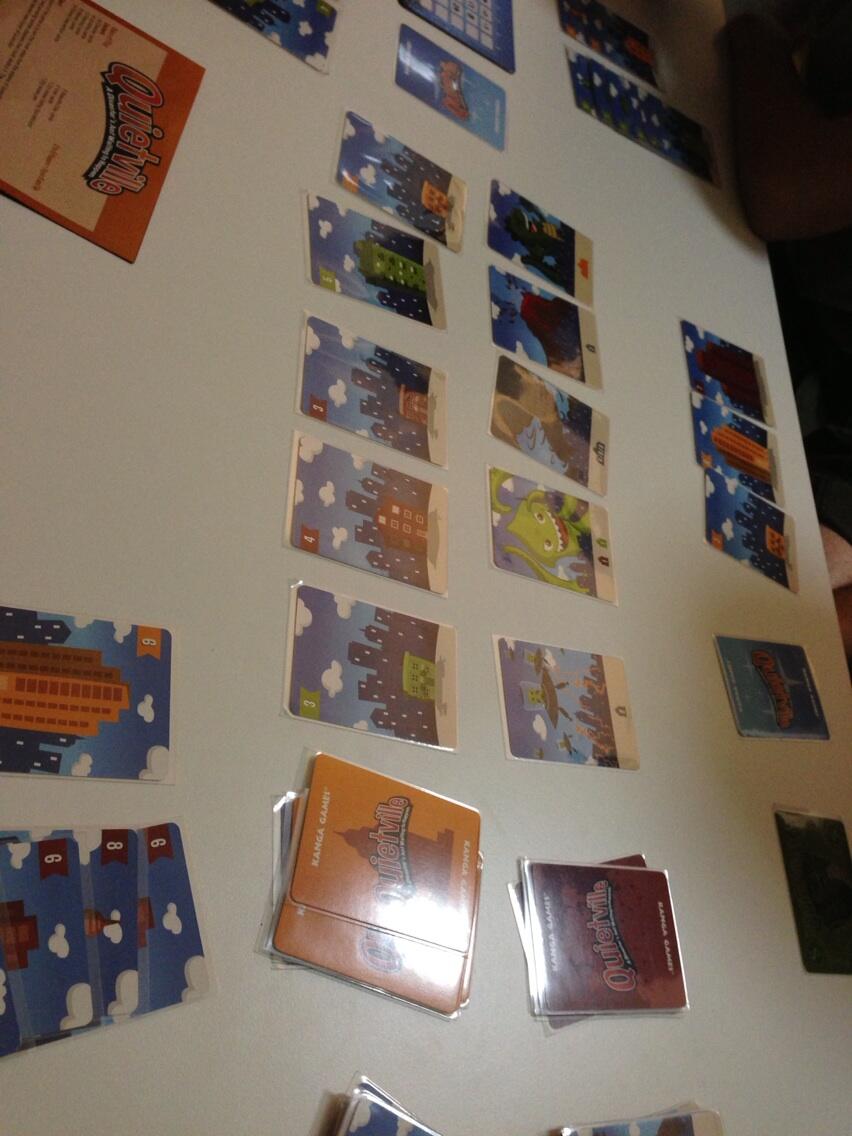
It is very quiet.. even with monsters...
Game Session and Thoughts: A light card game where players are trying to manage the number of buildings in front of them so that they are in the best position to score when any one of the 4 scoring phases card appear in the building deck. There is a set of building cards and disaster cards on the board. During your turn, you can either use 1 money card to purchase a building card, select a disaster cad and apply its effect and obtain a money card or play a Divine Intervention card (if you have any). You can only have a maximum of 2 money cards at 1 time so if you have 2, then you MUST buy a building card or play a Divine Intervention card. Building cards come in 3 colors and a variety of points from 3 to 8. Disaster cards cause you to lose buildings depending on what is indicated on the Disaster card. If you lose 2 buildings, then you will be able to obtain a Divine Intervention card. Otherwise, regardless if you have lost a building or not, you will obtain a money card. Divine intervention cards will usually provide you with special powers like refresh the row of disaster cards etc.
The unique part of the game is when one of 4 scoring cards appear in the building card deck. Whenever a building is taken, that spot is replaced with a new building card. In this way, the scoring cards will appear later on in the game and at the end. Players now choose 1 of 4 scoring types to scoring when a card appear. Players can only choose 1 scoring type per scoring phase for the entire game so players have to plan correctly otherwise they will waste these chances. The 4 types of scoring are: a) score for ALL buildings you currently have, b) score for each of the highest building for each of the colors, c) score for each of the lowest building for each of the colors and d) score all buildings of 1 chosen color. The game ends after the 4th scoring card has been revealed and the player with the most points wins the game.
For this light game, the scoring methods add a surprising depth to it. You have to see if you can hold out and get those buildings that will enable you to perform the scoring that you want. At the same time, you don't want to be caught where you have no choice to purchase but to take a disaster card that will devastate the buildings you already have. Art is quite comic like and nice and everything is clear, easy to teach and easy to play.
Pet Peeves: I think the most irritating thing will have to be the luck of the draw. If you are very unlucky, during your turn you may end up with the worse types of disasters (where you will lose a lot of buildings) or with the low scoring buildings or if you have a divine intervention card that doesn't help you at all. Otherwise, there is very little else that is wrong with the game.
Conclusion: So a light game that is easy to play and surprisingly fun with a bit of strategic planning but more tactical than anything. Whenever we saw a chance to take a disaster card that did not sabotage ourselves too much, we went for it. We did not really focus too much on the Divine Intervention cards as their powers while helpful aren't all that game changing. I did not win though but I still had fun. Try before you buy.


CITE
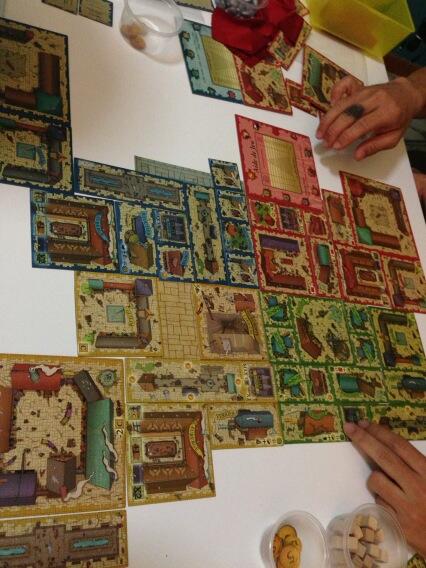


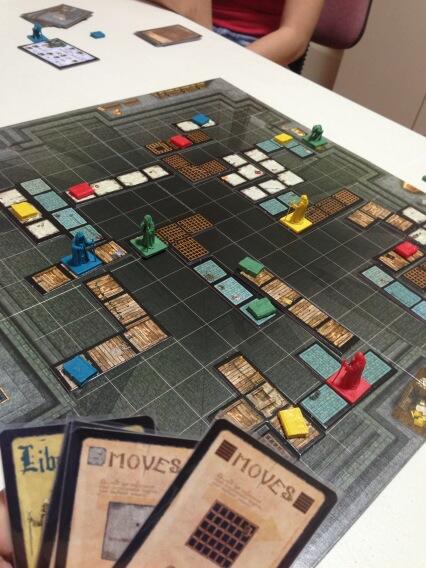
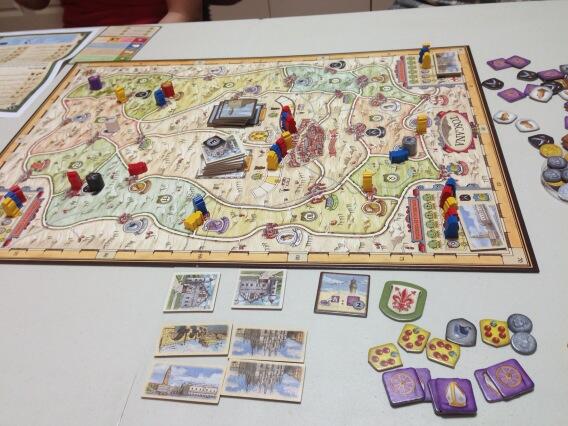
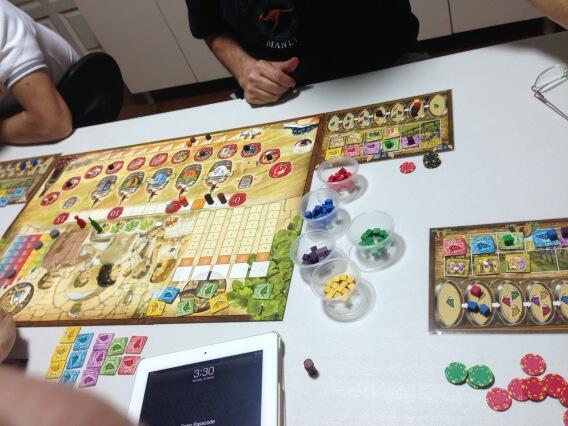
Game Session and Thoughts: A light-medium, negotiation heavy, tile laying game similar to Princes of Florence. Each player has a set of similar buildings which occupy 1-9 spaces. Your objective is to place/build as many of these buildings as you can within the 7 rounds. The player who has built the most spaces of buildings will win the game. At the start, players are allowed to place up to 7 spaces of buildings. Each player will have a unique resource which only they have (i.e. Yellow has the rock, Red has the cloth) and thus the negotiation is required so that resources from other players can be traded to create secondary elements. The interesting part of the game is how you can build the buildings. The more variety of materials you have, the less of them you need and the more spaces you can build. For example, if you only have 1 type of material, you will need 10 of them to be able to build 1 space. If you have 5 for example, you just need 1 of each to be able to do the same. To be able to create more materials you will need to build your secondary buildings, get the other base material from another player and then be able to build it OR trade another player who has built it. Game play essentially is income (production), negotiation (exchange of goods) and then build. Game ends after 7 rounds or whomever has built all their pieces and the player with the most built squares will win the game. As you can already tell, this game relies a LOT of negotiation although another player managed to build with minimal negotiation and exchange of goods. He also forced his basic material to be rare and hard to come by. In addition, you have to negotiation because of the close proximity of your buildings. Right in the beginning there is a game board where you can place your starting buildings which is the only area where each player's buildings can be adjacent to each other and provide additional benefits to each other. Gameplay can be pretty fast though unless negotiations bog down and cause a stalemate in the game. Components wise are rather good. In fact, they can be considered over produced! The stone are really small stone pebbles and the cloth is nice rich red cloth squares. But they could have done with red cubes and it would have been easier to handle and manage.
Pet Peeves: Its kinda odd but the playing area will extend beyond the main board. Since you are pretty much given free reign (except that the new building must touch an existing building), you can expand if you want all over your corner of the table. As mentioned above, the materials seems to be over produced. The red player had problem trying to count the number of cloth because, since this was a new set, the clothes were not separated before. Though if they used the cloth same as Marrakech that might have been easier to manage. You need like a bowl or something to keep the amount of material which you may have been able to produced given that the components are not all the same sizes. You may also need to supplement with your own bits as it did not seem to be enough. The game owner used lego bits to supplement what was provided. There is a building that functions like a Bank. You can place up to 3 materials on it and then get some returns. However since the bank building piece is so small, its a bit impractical to place them onto the building. Lastly, the building's functionalities are written on the reverse side of the building but when you build them onto your area, they look better the picture side up so kind of prevents us from referring to their functions once placed on the play area.
Conclusion: I am beginning to shun from pure negotiation games because well, I seem to suck at negotiations :P Some negotiation is fine but if its pure negotiation then I will approach with some apprehension. That being said, there is a lot of chance for "mistakes" in this game because everything is concurrent (the negotiation, exchange of goods and building), people can make mistakes accidentally and kinda takes away from the "pureness" of a win. Not saying that I won of course lol it was all I could do to not be last (Can't remember if I was last ....). So this game is not for me. Might be for you though so verdict is Try before you buy.


SHEEPLAND
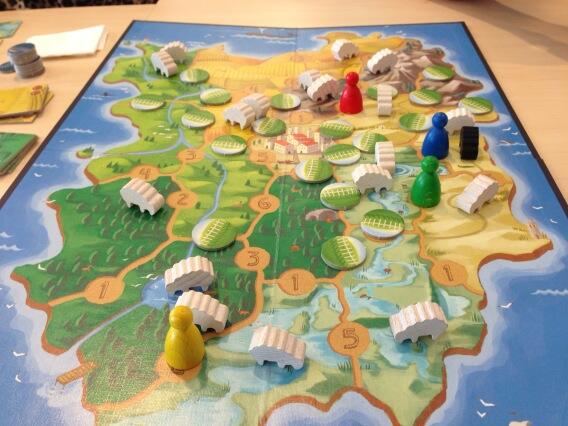

Game Session and Thoughts: Avery simple stocks and shares game that is masked with cute sheepples. Yes I said stocks and shares. You have a board with different regions (mountain, plans, swamp, forrest and grassland) and at the start there will be a sheep in every region. Each player starts with a secret land tile randomly assigned at the start of the game. During your turn, you will first roll a die to see where the black sheep may escape to (Black sheep counts as 2 white sheep). Then you can do 3 actions, out of which, 1 of them must be to move your Shepard. If you perform 2 of the same actions, then you have to move the Shepard inbetween those 2 actions (i.e. Action, Move, Action). Actions are moving a sheep (from one region to another through your Shepard), purchasing a land tile (either of the 2 land tiles that are adjacent to your Shepard) or moving your Shepard. That is it. The game ends when a certain number of fences have been placed on the board and everyone plays till the end of that current round. Players then count up the points they have (number of sheeps in that land area multiply with the number of that land's tiles you have) and the winner is the one with the most points. 
So essentially its a stocks and shares game because you are trying to amass a number of tiles (you can see these as shares) while trying to manipulate the sheeps into those land areas (price of shares). It is easy to teach and easy to play however it is quite a light game. Components are rather good looking and of course, the sheepples are very cute. It is interesting to note that most people are focusing a lot on the black sheep as it gets moved around but after a while when the black sheep gets cornered and stuck, then players will start to focusing on other areas. Diversity of the stocks (land tiles) is key here as you don't want to get trapped into only being able to buy those expensive tiles as money is VP at the end of the game and the initial tiles are free or very cheap. 

Pet Peeves: The board had some serious warping issues which is unfortunate. But other than that, there is not much to complain for this rather simple game. 

Conclusion: It is a very light game. That being said, there could be chances for screwage because you can often tell what an opponent is going for and move his sheeps out of the land areas that he wants. However to do that your Shepard has to already be in position or stalking his Shepard very closely. As this is probably a family friendly game, I don't think there's a lot of in built opportunities for screwing around with other players. There are opportunities for interaction but only if the Shepards are close together. So all in all, this is a light game and doesn't provide a lot of depth for me and I was glad to be able to try it but will not be making a purchase. Try before you buy.

Saturday, March 30, 2013

Suburbia, CO2, Sator arepo tenent opera rotas, Il Vecchio, The Cave, The Palaces of Carrara, The Doge Ship, Divinare, Plato 3000, Mord Im Arosa

I am so happy there's a good friday holiday which allowed me to get in some final gaming session before my nephew and niece arrives then  I won't be able to host any gaming sessions at my place for a while. Best pick of the week has to be Divinare with The Doge Ship coming in second. Lets see what I played and my thoughts:

SUBURBIA


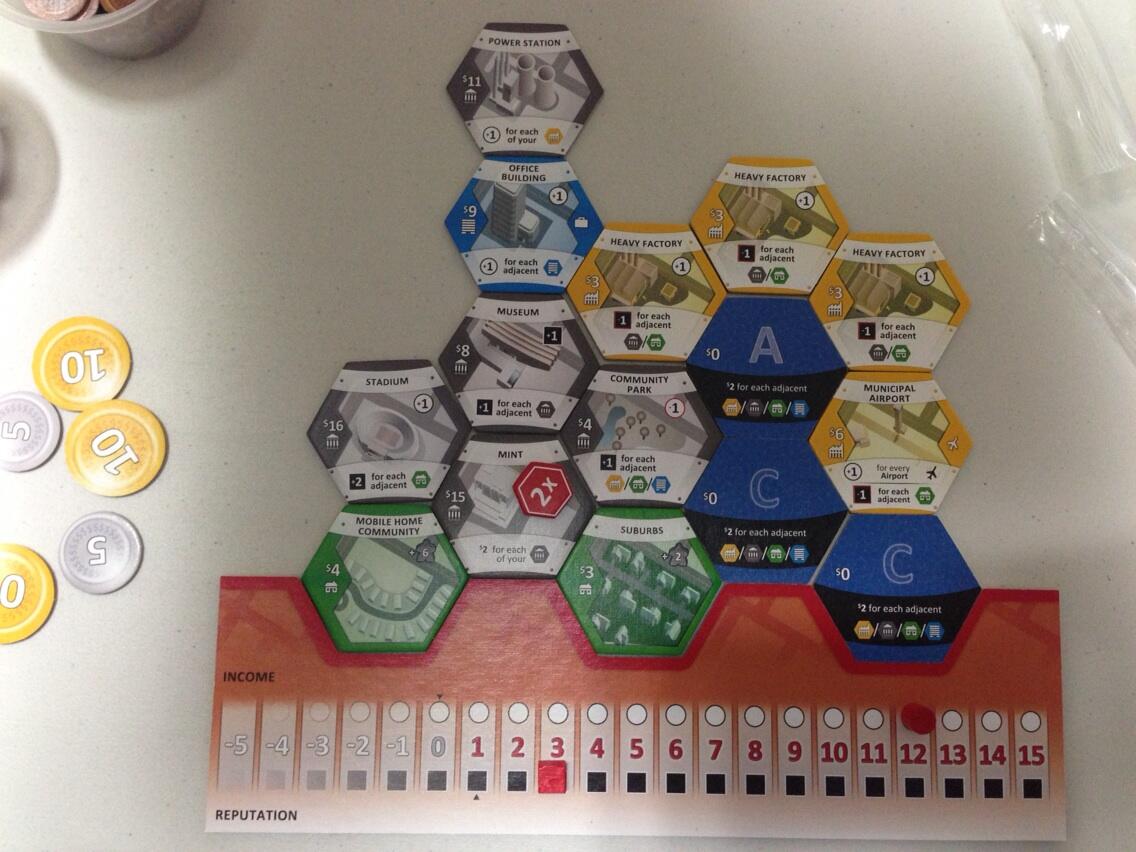
Mint did not save me :(

Game Session and Thoughts: 
Lost quite horribly and to 2 newbies (who have never played this game before) to rub it in! I think the main problem was that I changed my engine to a reputation scoring one too late into the game. I should have started to grab reputation instead of income when the B tiles starting showing up in the game. This game requires good planning and knowing when to change from a money generating engine to a reputation generating one. Timing is also quite important but some part is based on luck, referring to the tiles that are drawn. Sometimes the tile that you want will not be affordable to you but will be for someone else down the row. Furthermore, if the player before you is pretty much going on the same track then it will be quite difficult for you. 
Conclusion: 
I have ordered my promo from the BGG store and while I know it doesn't add a lot to the game I will welcome the variety. I twittered about this and Bezier Games replied that there will be an expansion for Suburbia and its already in the late stages of development! That I feel is what the game needs. Similar to Agricola and Le Havre 2 players, With a wider variety of buildings or perhaps even more features, it will increase the interaction amongst players as well as the replayability of the game. This is still recommended from me and I cannot wait to try a few more solos to hone my skills! :D 

CO2


I am the Black player btw...

Game Session and Thoughts: 
Ah finally I get to bring this monster out again to play it PROPERLY this time. Another friend was there and she was also hoping to finally play it properly after a mistake-filled first game for her. We were also using this to see if her sister was up to taking on heavier games. Short answer first, she is and she was scoring pretty well (our final tallies were in the 100+ which is surprising to me as well). Quite early on I ran into the issue which Jon previously talked about and which is a pet peeve for others and that is what is the point of me installing a project when it will just be stolen by another player? I had a small discussion with another player in my latest game about this and he mentioned that it is more beneficial to propose and install projects versus actually building them. Now I have not deeply analysed this to see if its true but if it is, then it certainly makes sense in a game that has quite a few rules already going against the norm (i.e. buying a CEP doesn't increase the market price). Now don't be mistaken that you can ignore constructing power plants entirely, you need to have a few for those quick scoring points and possible ownership of a region and thus grabbing all its left over CEPs at the end of the game and of course, to score UN cards, but perhaps the focus shouldn't be on over constructing. Perhaps a better plan is to install appropriate projects so as to manipulate the others to use up their resources or build plants where it is not very beneficial to them. 
Conclusion: 
I will want to give this game a few more tries to see if I can break through the surface and finally appreciate this game for all its worth. Right now it feels as if I am just only scratching the surface with this rather multi-layer game. I want to say that this game is recommended but I know that it is not for everyone and given the complexity to teach, absorb and then being able to play this game well, I will have to say its a try before you buy. Oh and do see if you can print out some stickers to pimp out your CEPs, they look much nicer that way ;)


SATOR AREPO TENET OPERA ROTAS


Green player won. I was Yellow.

Game Session and Thoughts: 
I wanted to bring this out again to see if it will survive to have a place in my collection. Sadly though after this play I don't think I will keep the game. This time we played with the full complement of 4 players and while I started sabotaging early on, it seems that we did not do a good job guarding a player and by the 3rd round or so, he had managed to collect all this books and won the game. I had only collected 2 by then but I was nowhere near the 3rd or 4th book. 
Pet Peeves:
This game requires a lot of spatial awareness and the 2 ladies that I was playing with were complaining about this point. We discussed a little as well about gender and spatial awareness and but I will not get into THAT discussion :P
Another pet peeve about the game is the luck of the draw. Sometimes you have cards in your hand that doesn't help you at all and instead of wasting a turn to draw new cards, you might as well play cards to try to prevent anyone else from grabbing their books. I suspect that if this was played properly (with everyone guarding each other), this could be a very frustrating game as there is no timer function that will end the game after a certain number of rounds.
Conclusion: 
After playing with 4, I feel that perhaps this game is best played with 2 such that you are aware of what each other is doing and you will be constantly either helping yourself or screwing your single opponent. We haven't really explored using the Gargoyle yet but it can be easily dismissed by opponents by them discarding 3 cards. Unfortunately, this game is not for me and I won't be keeping it.


IL VECCHIO


I won! Using the use Priest and get Wheel + $2 as well power
Game Session and Thoughts: 
I managed to get the initial tile which gave me the bonus that when I took 2 Priests, I will get 1 Wheel + $2 as a bonus. My plan was to use that to my advantage to and then travel around for free. I also decided to go grab an end game tile early so I know what I was aiming for. Those really helped a lot as my end game objective was to grab the Medici crests and I was scrambling to place my worker on the rows to grab the tile. It helped also that they gave me bonus 1 point each at the end of the game. The game is easy to teach and quite straight forward. Unfortunately there's not really a lot of theme to it so that may make grasping the concepts a little bit tougher for new players. Iconography is simple and easy to understand after a few rounds and the component quality is nice with good art. The only small gripe I have was the inclusion of 2 boards that are the same except for colors. I do wish they have provided a different board to add to the replayability.
Conclusion: 
I won with about 54 points but given that the scoring track is up to almost a 100, I am wondering if anyone can achieve that at all. Right now there is still a high replayability factor because of the different start bonus tiles we can grab as well as the bonus and end game scoring tiles we may get during the game. However I forsee that with many more plays the game may wear out. I am also not sure if this bonus tile that I have gotten is imbalanced but lets see if I manage to get future plays in if I can test this theory. Try before you buy!


THE CAVE


Yawn... when is it ending ...?


Game Session and Thoughts: 
This is my first play of the game. I have played K2 previously and that brought me into the gaming group (Cult Of The New) that I am involved in right now. The Cave is from the same designers as K2 and while I was hoping to give this a go I have heard mixed reviews about this game. 
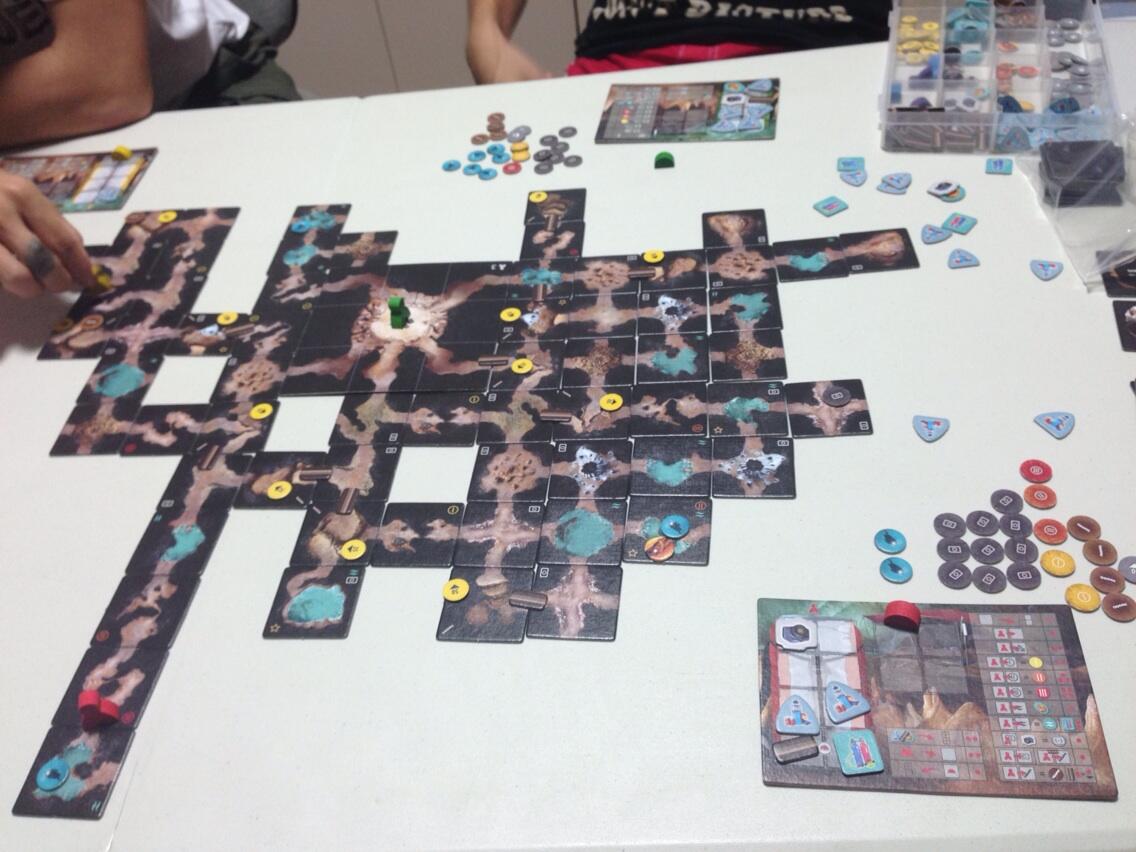
Players are all explorers trying to navigate this cave system, by means of tile laying) and collecting tokens for actions done (i.e. taking picture, exploring lakes or navigating narrow passageways). Players need to carefully manage their resources as well and when the final cave tile is placed, have 2 turns to make it back to base camp or be disqualified. Players then count up their tokens and whoever has the most points will win the game. 
Seems pretty straight forward game. We found ourselves moving around quite easily and then scampering back to base camp to replenish our supplies and then venturing out again. Repeat and Rinse until the last tile is revealed. I took a LOT of photographs and won by about 3 points. I did not do a lot of swimming in the lakes like my opponents but since most of the tiles I had revealed are photographs, I was lucky to win by that. That said, I don't have many good things to say about the game. What went wrong?
Pet Peeves:
For starters, I am not sure what the tent does. I mean it takes up 2 spaces in your backpack and you can spend 2 action points to set it up and gain access to the 4 spaces it provides. Ideally, it should allow you to extend your range so that you can explore further but the catch seems to be how are you going to get back to base camp then to replenish everything? If you can head back to your tent and replenish all the time, then that makes the tent much more valuable but for the entire game none of us were using the tents except when my friend tried to test the mechanism for this.
Supplies are a pain to manage. You are quite limited in terms of exploring tiles by how much supplies you are carrying before you have to high tail it back to base camp. If you run out of supplies, then you are spending your turn mostly moving 1 space. Its horrendously slow and painful if you do that as my friend discovered. As mentioned above, the tent doesn't seem to help much at all! Very odd.
The depth of the cave creates a very odd perception and some confusion with us. When you place a tile that has a rope icon, that means that this tile is deeper so you place a 25meters icon if this was the first you encountered. Now if you descend and encounter another similar tile, you place the 50meters icon and so on and so forth. However, there are cases where 2 separate tracks may be joined by placing a single cave tile and there in lies the problem of depth. If the 2 trails were of different depth to begin with, what happens when you join them together ? This depth concept may seem interesting and thematic, but game play wise can create confusion and I feel that it should be explained more clearly in the rules or with more examples.
Finally, the bits. There are a LOT Of chits for all different types of challenges faced as well as supplies, ropes etc etc. SO MANY MANY that you need a good plano box to ensure that everything is sort out nicely for easy setup and tear down. 
Conclusion: 

This game did not grab me like what K2 did. My friend commented that in K2 at least you can see clearly where you are heading and plan how to get there whereas The Cave is largely due to luck of your draw. You may end up getting screwed if you keep exploring lake tiles when you don't have a raft or oxygen tanks and have to head back to base camp just to reconfigure your inventory. Gameplay can get draggy as well due to the number of tiles you have to explore. Some players I guess can potentially drag the game on if they focused on clearing all the available spaces and not on exploring. This was a MEH for me and is not for me. Not recommended.


THE PALACES OF CARRARA


Spin spin the wheel...


Game Session and Thoughts: 
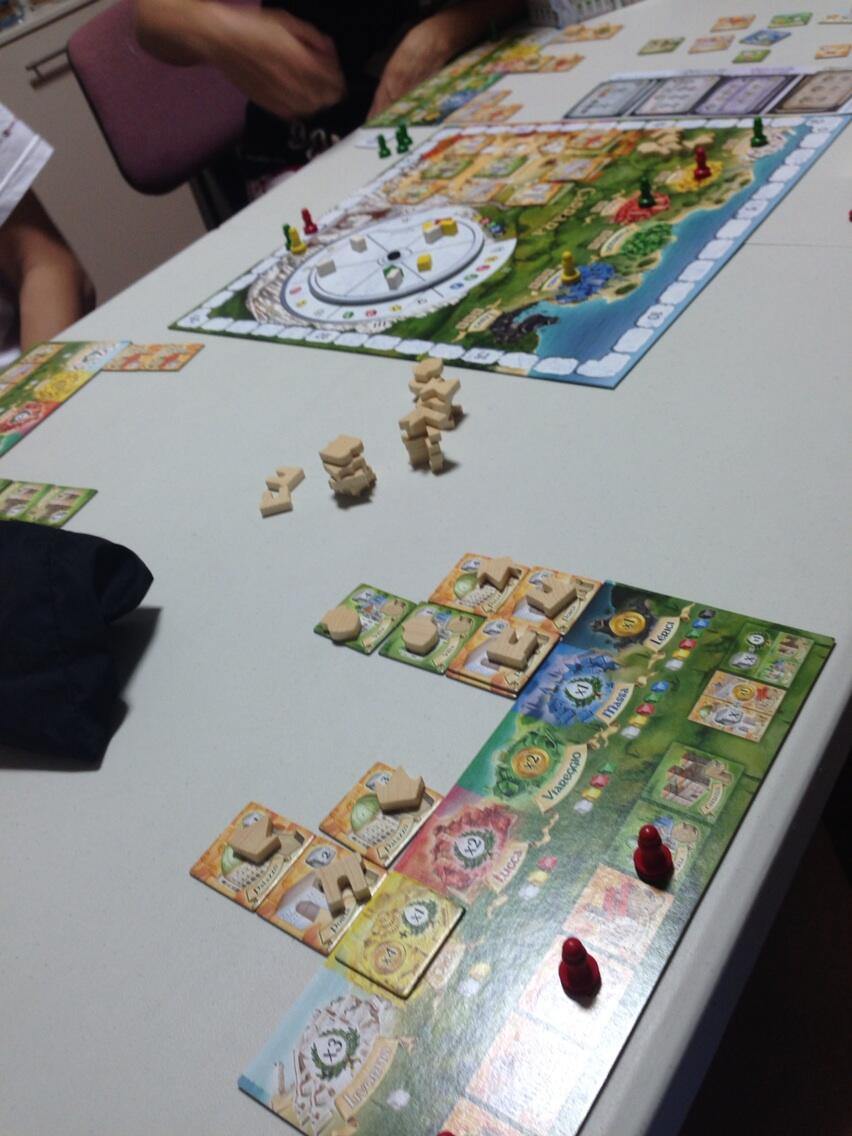
This is my first play of the game. Ah another essen release which I have heard about and was interested to try but not interested enough to grab myself a copy. This is a game that includes a sealed envelope with instructions for an advanced game and advice that you play the basic game a few times before you embark on the advanced game. Being the seasoned gamers we are (*wink wink*) we decided to jump straight into the advanced. My opponents have played this once before but this is my first game. Explanation was simple enough  and I could grasp the concepts easily. In the game, you are trying to manage your resources and determine when is the most opportune time for you to make use of your 6 scoring pawns (each can only be used once in the entire game). When some has met the end game conditions (3 cards determine the end game conditions), he/she can declare the game is over and score extra bonus points. Players then tally up all the points they have on the board and whoever has the most points is the winner.
There are quite a few interesting mechanism to the game. First is the resource wheel. At any 1 time, there should be at most 11 blocks in various colors (6 altogether I believe). The wheel is also divided into segments which shows prices of each color of block and are different from segment to segment. During your turn, if you decide to make a purchase from the wheel, you can either just select a segment and buy the blocks on it (any number) and pay the costs OR rotate the wheel once, populate the starting segment to top up total number of blocks to 11 and then make a purchase. 
The blocks are used to buy building tiles which you can then place on different sections/cities on your board. The requirement to build the buildings is you must pay a number of blocks as denoted by the top right corner of the building tile and also depending on the section/city you wish to place. Leftmost city is WHITE and only allows building tiles which you have paid in WHITE blocks only. next city accepts buildings paid with YELLOW and/or WHITE blocks and the right most will accept buildings paid with ANY blocks. 
The most important concept of the game are the scoring pawns. During your turn you can, instead of any of the other actions choose to score by placing a scoring pawn onto any of the scoring sections on your board or on the main board. On your board, you can for example, score all building tiles that have the same icon on it. Thus, depending on which city the building is in, you will score points/money or both. You will also collect that many icons as the number of buildings you have activated. The other type of scoring will be on the main board and only 1 scoring pawn can be allocated to each scoring space. These scoring spaces will score for all buildings in a particular city but only if you meet the requirements (i.e. for the Black city, you can only score if there are 3 buildings in that city). You will also get the tokens for those buildings you have not previously activated. 
The final concept will be the objectives board which will show you 3 scoring objectives that also represent end game conditions as well as a bonus objective.
It is quite a fun game with good art, nice component pieces but not exactly dripping with theme. The scoring spaces make for a tense game as well because you need to monitor what your opponents are doing less they activate the scoring before you do.
Pet Peeves:
This is like a multi-player solitaire because the only interactions you will have will be the market where you can buy the stones and the limited scoring spots. But often I don't find myself being overly affected by these and was pretty much doing my own thing and playing my own game. Limited interaction.
There is also a runaway leader because it is often quite difficult to block someone from building in their city unless there is a cooperative effort to empty the market of that particular block. Our end game scoring were quite far apart with 2 of us almost getting looped by the leader.
Conclusion: 

Its a light-medium weight Euro game that mixes a few interesting concepts together. Quite nicely executed and easy to learn and play. Not much interaction though. I will play it again but probably not like it enough to grab my own copy. A friend mentioned that this second time he played it did not seem as fun as the first. Oh I did not mention that timing is very important in the game because while you will often want to wait and store up resources before buying and scoring but if someone else grabs the spot before you, it may screw with your plans a bit. Try before you buy!


THE DOGE SHIP


Much screwage was committed...


Game Session and Thoughts: 
This is my first play of the game. I have heard of this game and seen the box and all but wasn't too interested in it. Still I was glad to have been able to give it a go when my friend bought it and brought it over. 
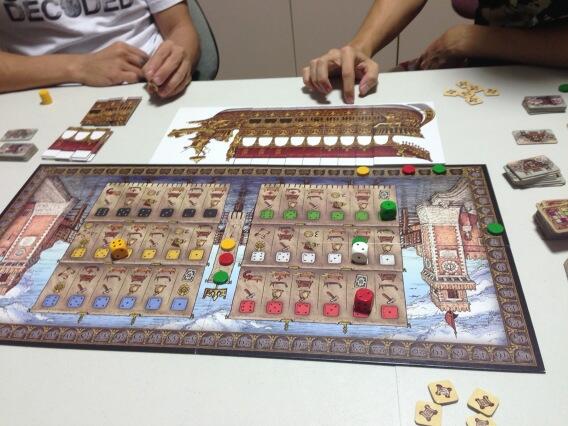
The game is a light-medium weight euro where players are taking actions using action discs to build gondolas (for money and scrolls), barriers (for protection against high waters and special benefits when taking other actions), get money, purchase plans for gondolas and barriers and ships and ultimately, building the Doge ship which will also allow the game to end when the entire ship has been built. 
At the start of a round, the start player will roll a number of dice (depending on the number of players) and place them in the corresponding track. All actions spaces up to where the die has been placed (i.e. if the red die is a 4, then action spaces to the left and up to the die can be activated) are free. Each spaces beyond that die will cost an additional $1 (i.e. if you want to activate Space 6 and the die is on 4, you will need to pay $2). Each player will have a number of action discs and taking turns, each player will place their action disc onto an action space and perform that activity. When all players have gone their turn, players will check the event card to see if it is High water or the Doge has arrived for an inspection. 
For high water, players check the number of barriers they have against the number indicated on the event card. If they have less barriers, they will lose 2 action tokens for the next round. If they are equal, then they lose 1. Otherwise they are safe. 
If its an inspection, players will now secretly bid a number of scrolls they have collected. The player with the most scrolls will score 6 points, the 2nd, 3 and so on. 
The game will end only if the entire Doge ship has been completed and then players have a final inspection and whoever has the most points will win the game. 
So you are trying to effectively chain your activities such that you can build 2 things with 1 action disc rather than taking 2 turns to build the things that you wanted. You are also trying to earn enough money to be able to buy a ship component and then build it later before your opponents do. There are 6 different sections to the ship requiring different number of ship components to complete the section however there is a space on the board which, when activated, allows you to replace another already built ship component. Art is quite straight forward and easy on the eyes. Components are nice cardboard quality chits. Interestingly, there is a money track instead of money chits to denote how much money you have.
Pet Peeves:
The main pet peeve will be the length of the game. We had quite a lot of fun building barriers and gondolas but not so the actual ship itself. If all players end up milling around and not building the ship, then the game could drag on and be lengthy. However, since building the ship will score you points, I don't think this will be a big issue.
Conclusion: 

It is a nice game but doesn't bring much new things or concepts. Most of the mechanisms you will have probably played in other games already so nothing new there. I will play it again perhaps with 4 or 2 and see how that goes. Try before you buy.
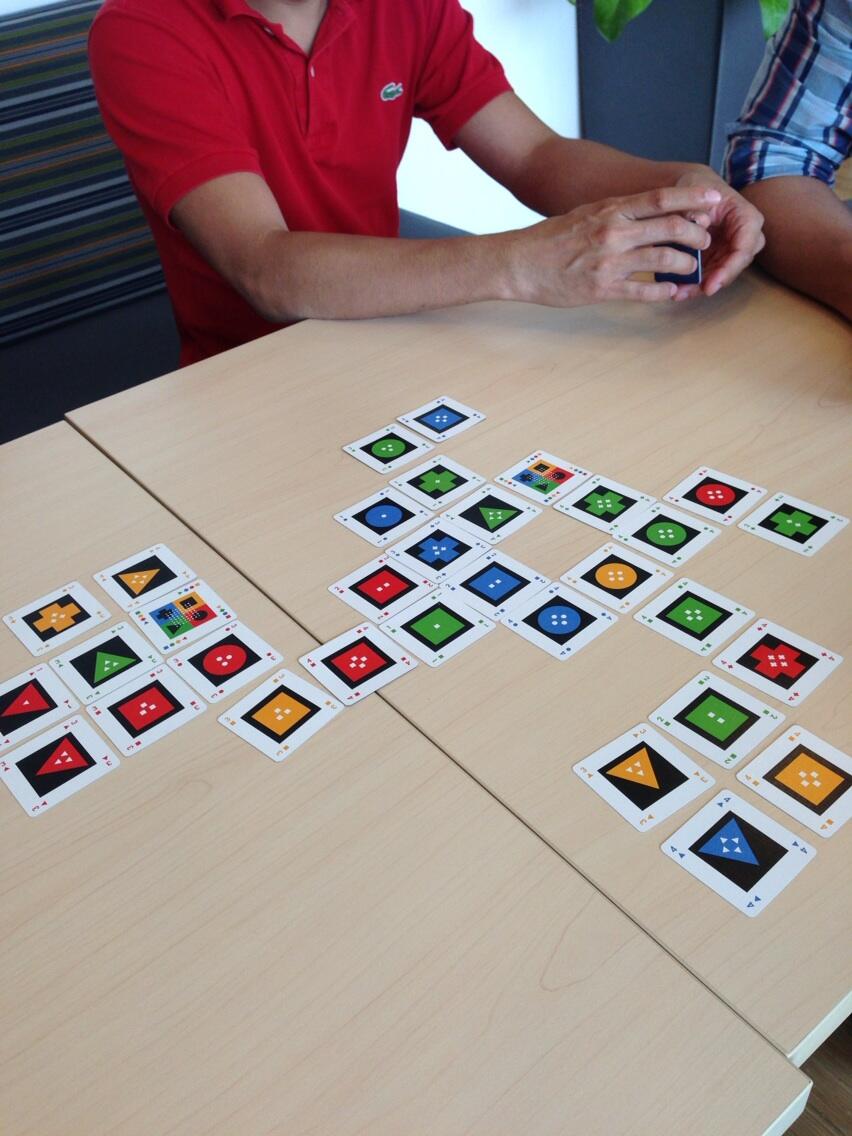

DIVINARE


Wait did I already see 4 yellows? Is that the only Yellow left in the game?


Game Session and Thoughts: 
This is my first play of the game. Now I have seen this game and heard of its hype at GENCON 2012 but I had thought it was a light filler and did not look too much into it. Besides, at that time I was more interested in Seasons from Asmodee :P Boy was that a mistake after playing my first game last week. 
The game is quite simple to play. Players will have a certain number of cards in their hand. These cards belong to 1 of 4 colors (red, yellow, green and white). At the start, you will pass a certain number of cards to the player on your right. This "event" will occur a few times during the game, depending on how many cards all players have left as well as the number of players.
During your turn, you have to play a card and then move your token for that location (i.e. play yellow card, activate your token in the yellow area) either to another spot. Now each location has a few sections with numbers on them. The aim of the game is to place your token on the number that you want to guess for that color. You are guessing at the end of that round, how many cards of that color has been revealed. If you are spot on, you will score 3 points. If you are adjacent to that number, 1 point and if you are way off, you will be penalized 1 point. There are sections at the extreme ends that will give you extra bonus points if you score.
After each player has had a chance to be the start player, the player with the most total points will win the game.
What surprised me was how deep the game eventually became for me. Initially after the rules were explained, I was thinking "Oh, this will be a simple game to play..." Then as the game progressed I was thinking "ok I have seen 3 Yellows, shall I pass them along or keep?" Then it was "ok now I have received some more Yellow cards... now wait how many was that ?" 
During my turn, I suddenly realised "Oh my... I will need to play a card AND move my token EVERYTIME? That will mean that if I knew the exact count (or have a pretty good idea), I will still need to play my cards in such a way I will still remain in that number to win the 3 points!" 
As you can tell by now, this game has many layers and its not as straight forward nor as simple as I had initially thought. Do you pass your card to someone else so that you can lock in your choice ? Or do you choose to forgo your choice (you can move your token back to the starting point and not suffer penalty) so that you will not get penalty ? So many choices and it makes for a nice meaty game.
Oh and production value is really good and the locations look very realistic and 3D. Art is also nicely done.
Pet Peeves:
So does this game have issues? Well if you are prone to Analysis Paralysis then yea. You may be trying to remember all the cards that have been played, start to calculate the probabilities and thus not be able to make a decision. 
Some can also say that the luck of the draw is important. But all these are minor quibbles I feel. 
Conclusion: 
Well as you can tell by now, this is my biggest surprise and hit for this week. The intricacies and the depth of play really surprised and astounded me. For such an easy game to teach, it sure packs a punch and I highly recommend this game! Go grab yourself a copy now!


PLATO 3000


Game Session and Thoughts: 
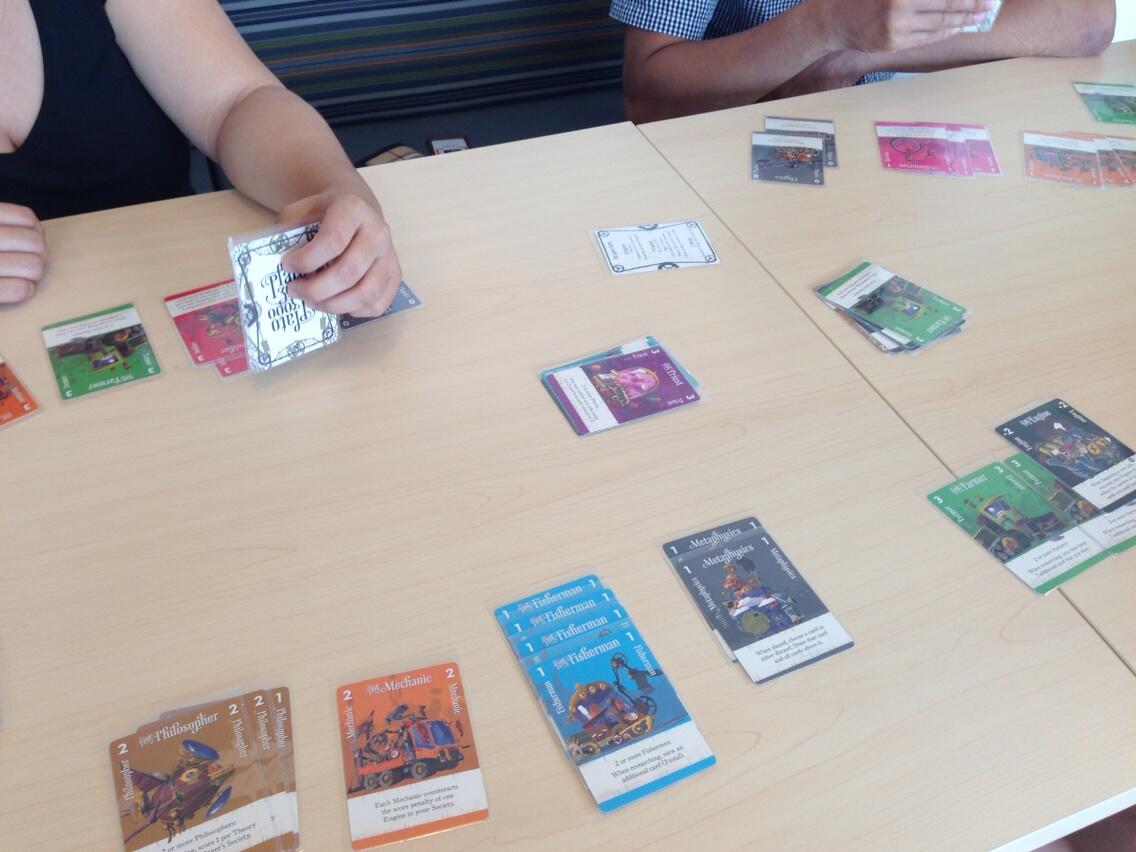
Been some time since I brought it out to play this and I think that having played a few more of similar type of games (set collection or light card fillers), I think the shine for Plato 3000 is starting to wear off. It could be that the lunch group was suffering from lunch-food coma ( ;P ). It could also be that for 4 players the game doesn't work as well. Might be good for 2 or 3 but maybe for 4, we will need 2 sets to really speed things along. My colleague who played it once before and did not like it initially but after this session she liked the game. She's not too sure why she liked it better this time lol...

Conclusion: 
I think that this game really shines with 2 or 3. Though with the influx of similar games like Guildhall and to a lesser extend, Love Letter and Coup, not sure if this has enough legs to carry it past the rest to shine above them. For me so far I think Guildhall and Love Letter seems to be beating Plato 3000.


MORD IM AROSA


Game Session and Thoughts: 
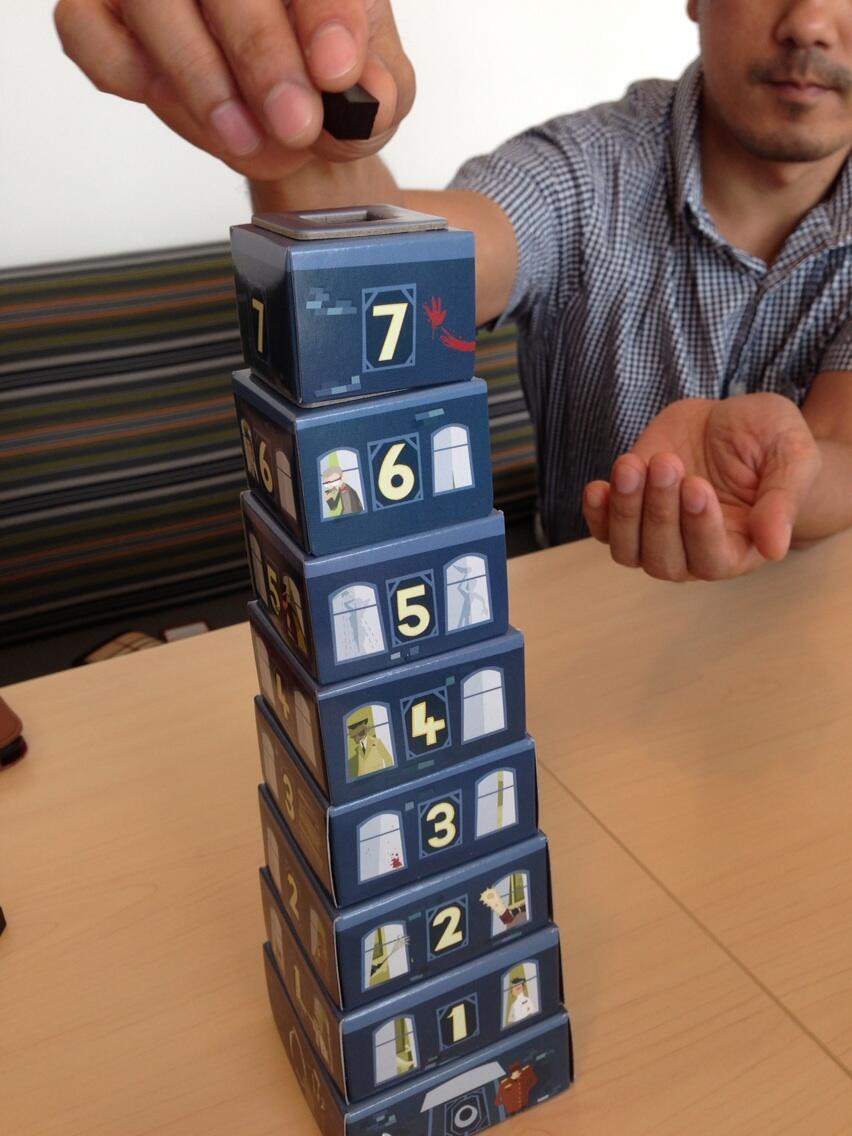
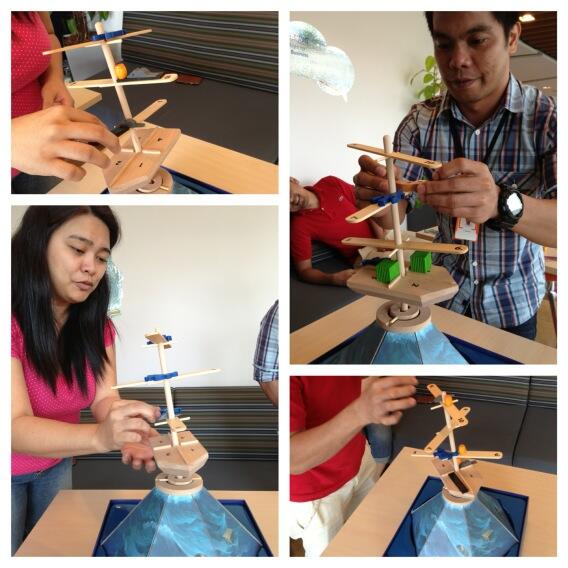
I got my own copy after playing it previously and I was eager to break it out with the office and see how it went. We had more fun probably dropping the pieces in and trying to guess where they are than the actual revealing and guessing itself haha. Its interesting in that when we dropped, I could have sworn most of the cubes were stuck in floor 5 or 4 but when we revealed we were surprised there weren't many there. Its amazing how our ears can be deceived and this makes the game that much more challenging. Gameplay wise it is a very light game with the tower as the gimmick. Its good for new comers to get used to what we call boardgames and open their eyes but probably only scratches the very top of my itch for deduction games.
Pet Peeves:

The base where the tower sits on (or table) will probably be the easiest to guess because cubes dropping through the cardboard will not sound the same as the table the tower is resting on. That being said, it can still confuse others especially because your own cube needs to be sitting there else you will be penalised. The other Peeve I have is the way the tower is built. If you have an improper tower (i.e. some of the cardboard pieces aren't sitting nicely) then your tower maybe skewed. Anyway, these are just minor peeves to a light party-like game.

Conclusion: 

Definitely not a game for heavy or even medium weight gamers I feel but can only be a light filler with the tower as a gimmick. Its nice to assemble and look at and play it once or twice but in the long run it probably will wear off the freshness of the game. Still, a try before you buy.

AOB

If you would like us to review your games on the podcast and on this blog, do leave a message on boardgamegeek (my nick is duckizz) for me and I will pass you my details. Also, if you would like to support my blog and the podcast, please click on the ads at the side of this blog and leave ratings and reviews for us on iTunes.

THANK YOU!

Saturday, March 23, 2013

Bora Bora, Guildhall, Straw, Grand Cru, Nieuw Amsterdam, Sator Arepo Tenet Opera Rotas, Riff Raff, Iota, Loopin Louie

Highlight for me this week is Nieuw Amsterdam. Its a new game for me and pretty fun to play!
Lets see what exciting games I have played this week :)

Bora Bora


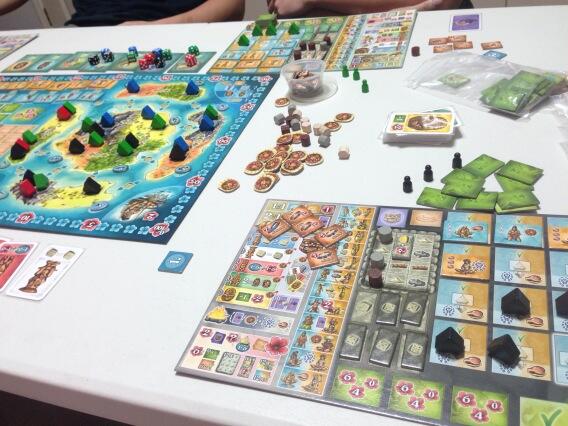
Game Session and Thoughts: Manage to bring this out again and with more plays, I am getting better at managing what I want and the objectives I can accomplish. For most of the games so far I will attempt to complete all 9 objectives but that kinda dictates what I will be doing as my entire game is to try to get the various requirements done to achieve my objectives. I also managed to buy 6 pieces of jewellery and quite high scoring ones to get quite a few points. I was attempting to get the max points for tattoo by activating all my men tiles at the same time but only managed to get halfway. I have been listening to Joel and Lance's podcast and they talked about bora bora as well and what Joel said is pretty true. If during the game you find yourself in the lead most of the time, it means that you maybe doing something wrong or not maximising what you can do during the game.
So far I have not seen anyone manage to place all 12 huts onto the board OR fill up with 12 man/woman tiles. I think that is one of the more difficult ones to achieve for end game scoring. It seems the "filling of the 12 spaces" as well as building 6 of the tiles onto those 12 spaces are the best objectives to obtain since its possible to achieve both end game objectives at the same time, scoring you 12 points. Second easiest will be the jewellery but that is dependant on how the setup was like. Third will be the objectives and that is quite lucrative too because if you manage to complete 9 objectives you will at least have 4x9 = 36 points but you could have 6 x 9 = 54 points.
Pet Peeves: One kinda irritating thing I have found about this game is that setup is rather tedious. I will recommend having a bag each for the objectives, man and woman tiles. This will allow setup to be pretty fast as you don't need to sort them out. Another smaller peeve is that explaining how the game works can be quite lengthy because of all the different actions available as well as Phase B sections and the end game scoring. It will require multiple plays because most new players probably won't remember what the end game scorings are until halfway through the game which will not afford them enough time to switch plans halfway and switching goals halfway in the game can be quite detrimental. Jon pointed out the issue where the game seems to dictate what you can do because of the decreasing points in latter rounds for building and increasing points for the number of priests that you have. I can understand his point of view because I also box myself in by going after the objectives and thus determine what i need to and can do to get the points. Still I guess it makes it easier to let new players understand the game and get into it and give them a fighting chance against experienced players.
Conclusion: Still highly recommended from me.


Guildhall


Game Session and Thoughts: So after last week's playing 2 player I manage to play this with 3 and 4 and I must say 3 players is probably the sweet spot for this. It gives you an extra opponent to guard against and attack and doesn't extend the game play time for too long. Also gives an opportunity to guard against the leader. 4 may cause the game to take too long to finish. Surprisingly as you play the game, even though there maybe an early leader, usually every player will start to guard and disturb the leader such that the rest can catch up. This leads to very tense and exciting last few rounds as players try to win it themselves.
Pet Peeves: Unfortunately though, usually in the last round it is a forgone conclusion who will win and probably there is nothing else for the other players to do unless the luck of the draw allows someone else to catch up. Definitely recommends it with 3 or 4 but not so with 2.
Conclusion: Still a Try before you buy. Jon hates the art lol and will want to retheme it. Suggestions anyone?


Straw


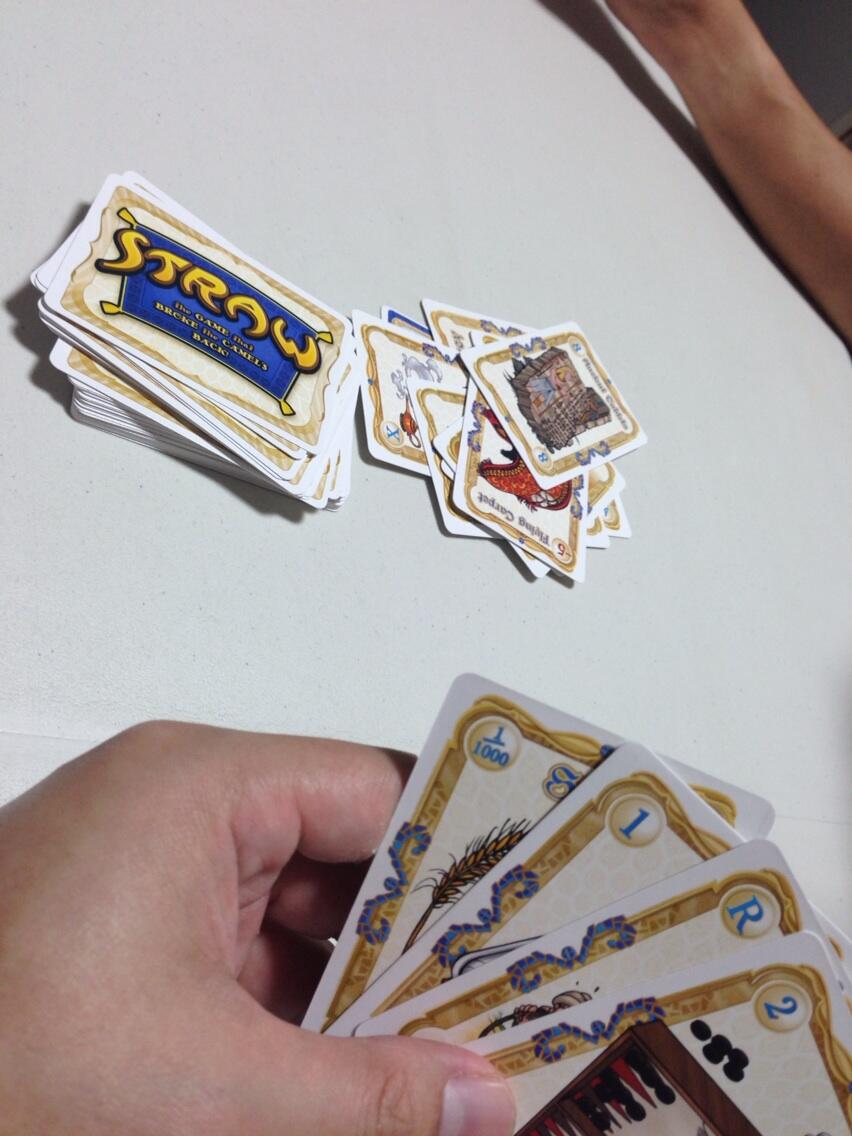
Game Session and Thoughts: Straw is a light filler card game very similar to Zeus on the Loose. In the game, players are playing cards which represent goods with a certain weight/number. If the sum of all the cards on the camel (first card in the centre of the table) exceeds 50, then that player has "broken the camel's back" and all other players will score the cards in their hand for points. However there is a special card that is the Straw which if you use it to break the camel's back (i.e when it comes to you and the sum is 50, you play that card), then only you will score points. Game lasts as many rounds as there are players and the player with the most total points will win the game. Its very similar to zeus on the loose in that you are playing cards with numbers and having a sum total that you are trying not to exceed (in this game) and trying to exceed (in Zeus on the loose). In Straw, there are only a few "special powers" like reserve play order and the magic carpets which provide negative points. For Zeus, there are god cards with special powers which adds more variety but can lengthen the game if all players are actively blocking well.
When I played this initially, I was playing all my low weight cards so as to keep all the high weight cards but I quickly found that this was not very good as well because nearer the end when the weight is almost to 50, having a few of those low weight or negative cards will help to prevent you to be the player that breaks the camel's back!
Conclusion: This game is definitely better with more players (plays 2-6) and quite a nice filler. Recommended!


Nieuw Amsterdam


Game Session and Thoughts: Saw the video review from Joel and wanted to give this a go. This is a medium weight euro game that is sort of area control and with a rather unique action-selection cum auction mechanism. In the game, players are trying to score as many points as they can and this is usually done in game by means of shipping fur or scoring for your buildings in the town area. There are quite few phases in the game but the first thing you do is auction or bid for actions. Now this is quite unique in that there are 5 slots available and at the start of a round, you will randomly place action chits onto the available slots. Some slots have space for 3 action chits, some have 2. Some slots also gives 2 coins if you win that slot. Starting with the first player, you will place your turn order chit on the slot that you are bidding for and declare a price. This is a once-only auction in that if your bid is the final bid so you will need to choose wisely. Once someone has won the auction (after each player has bid or passed once), that player then exchanges his turn order chit with the one that was placed in the slot (if he has any remaining) and the player that initiated the bid will get the turn order chit (if he/she wasn't the player that won the bid). Once all players have won 1 slot and obtained the action chits, the player will go through 3 phases which are denoted by the action chits.
The first action is a city action and in player order, players will determine a special action and if they have the action chit for that city action, take one of 2 available city actions. The order sequence between special action or city action is determined by the player. City action allows you to either build 1-3 buildings into the town area or score for town areas where you have majority or drew with other players. You will still be able to perform a special action even if you do not have a city action chit.
The second action is a land action where players can obtain land deed cards (That are not cleared in the beginning) or clear land deed cards they already possess provided the building slots of each land deed card is already filled with their buildings. By clearing, you will score points as well as obtain a number of wood pieces and get corn during the income phase. Again, players can take a special action.
Third action is the fur action where players can use the action chit to either obtain fur with goods from the market or ship their fur and obtain points (determined by how many sets of the same fur they have), coins by fulfilling the requirements of the ship cards available. These ship cards also provide Goods during the income phase.
Take note that the special action that you can play in each of the 3 action phases I just described are denoted by the various town spaces. If you have majority (more buildings than others) or drew with the others, you don't need to pay 1 coin when activating that town area's special action. Special actions include trading coins for wood or vice versa, building new warehouse to store goods etc etc.
After the action phases, players will collect income for corn (if they have cleared land cards) and pay corn for each building they have in the town area. Penalty for not being able to feed will be removal of buildings as well as 2 points for each building removed.
Players will also receive goods from any ship cards they have and finally income by counting the number of buildings they have in the town area and +1 for each area they have the majority. That will be the end of a round and at the end of 6 rounds, there will be a final scoring phase (where majority of the town areas will come into play as well as any remaining goods) and whoever has the most points will win the game.
Conclusion: As I mentioned, the auction phase is quite unique because the order in which the action chits are selected as well as bided for will determine what actions you can take during that round. Do you want to bid for the 3 action chits which allow you to perform all actions during the action rounds? Or do you want to perform a specific action twice? Do you want to win that action just to go first? In this game, going last has its advantages because during auction you can get action chits for 0 coins and at the same time you get the last action. For now at least after 1 play, I can see going first as not being all that lucrative. Interestingly, I went for the land card and majority in town area path and I did win the game but my closest competitor did not have a single building in the town area and opted to go for the fur trade instead and he wasn't too far off from my final score. So this does show that there are different paths to victory but since there are only 3 main areas of scoring, it doesn't have that much variety. Probably the most random thing in the game are what fur is available on the market as well as the action chits that will be available in the different slots. Quite a fun game for me and I will definitely want to play it again. Recommended!


Grand Cru


Game Session and Thoughts: Another wine game? Yup and this plays, for me at least, better than Vinhos. In the game, players are trying to have the most money at the end of the game. Players however, do not start with any money and must take loans to get money right during setup. Play then goes in player order and each round will last at least 4 turns but can be extended either when all players have passed or 1 player has no more cubes (denoting wine) on their vineyard tiles. During the turn, players can choose from a variety of actions from bidding on tiles that are available in the market, selling already harvested wine (cubes), bumping up the prices for a particular color of wine to harvesting a wine etc etc. Once the first phase is over, then there will be a wine festival at the end of the round. Players will score prestige points depending if they are in the majority for wine of a color sold or if they few. Then in player order, players will be able to spend these prestige points (which are accumulative between each round) to obtain certain benefits for example, an extra sale action or obtaining money etc. Once all players have passed, then players need to pay interest for the loans they have and then decide to take more loans or payoff the loan. A new round will then begin. The game ends when at least 1 player has payed off ALL his loans or if a player is bankrupt and cannot take any loans. Then player sell off all their wines they have previously harvested, score points for the different types of wine/improvement tiles they have and then whoever has the most money will win the game.
Pet Peeves: This game has horrible iconography. There aren't that many in a game where there are quite a few rules and whatever is there isn't very helpful. We had to refer to the rulebook so many many times to understand what each tile does. Also, its so difficult to find the english version of the manual and even the geek only has a no-picture only user-created manual. Gameplay though its faster to learn and play as compared to Vinhos and not as brain burning.
Conclusion: I had fun and this game shows that short term gains will often always lose to long term gains which may or may not be a good thing. There are interesting development tiles which cannot be ignored and will allow actions such as being able to harvest 2 types of wine for the price of one.  A good combination of action tiles will enable you to perform so many things that are often limited by the number of turns each round has. Not a bad game and I would say its a medium euro I will definitely want to try it again but for now it will be a Try before you Buy for me.


Sator Arepo Tenet Opera Rotas


Game Session and Thoughts: The game with a very difficult to pronounce name lol. Its a palingdrom btw and you can google up the meaning. In the game, there are 4 books of your color spread out all over the board. You are tasked to retrieve all 4 books and the first player to do so will be the winner. During your turn, you have 6 action points with which to play cards that will rotate or move tiles that represent footpaths on the board. Each player also has a set of special power cards that provide very powerful options for example, destroying footpaths or allowing your pawn to leap over open spaces. During your turn, you also have a free action which allows you to move your pawn 1 space or rotate or move a footpath 1 space for free. After you have played your cards, you will get to move your pawn a number of spaces depending on how many of the general card (not your personal more powerful cards) you have played and then you get to draw back up to 6 cards (either from the general deck and/or from your special power cards).
I played it with 2 and even though I was leading in the beginning my opponent quickly drew level with me. With 2 players though it came down to choosing between blocking me or moving your pawn. He tried to block me a few times but in the end if he wanted to win he had to move on to grab the last book. I was very lucky with my card draws and the game was pretty much going my way most of the time. I think with 4 players it will be even more tense as if the opponents decide to gang up against the leader, the leader will have quite a hard time trying to win.
Conclusion: This game is just BEGGING to be rethemed in the style of Harry Potter! Components wise they are quite nicely done and the books are quite detailed. There is a set of initial placement cards which will help determine where the books are setup but that's all the function they serve for the entire game. That kinds seems redundant. Still this is quite a unique game and it will be a Try before you Buy for me.


Riff Raff


Game Session and Thoughts: I played this first with my usual Cult of the New gaming group and I decided to grab myself a copy to bring to the office to play. Now with my CotN group it was all quite relaxed and fun and I was goofing off since i really sucked at agility games. In office I was surprised that everyone was being all serious and positioning themselves to catch the falling items. I played again last night and an opponent even used a tactic where she purposely placed it such that items will fall and she can catch the falling pieces thus not being penalised too heavily! Trust people to try to find a way to game a party game hahaha....
The components are very nice wood grade and well done. I also found out that depending on how you setup the ship and planks etc, you can adjust the difficulty of the game and thus replayability is very high on this. Its a pity it only plays up to 4. So far in the games I have played there isn't a case where there are more than 5 items on the boat at a time as pieces tend to fall off pretty easily. The cards add a nice level of strategy because you will need to decide when best to be placing at a certain space on the boat and if your opponents before you may have cleared the boat of items for you, making it easier for you to place your item.
Conclusion: Surprising depth for a party game. Recommended!


Iota


Game Session and Thoughts: Played Iota again twice this week and boy what a thinky game it is. Again so far everyone who has played it really liked it and for such a small box it certainly packs a lot of game. Its incredibly hard though to catch the leader once someone has done a massive scoring and so this requires players to all be on their toes making sure they don't set up a 4-card play for another opponent. This maybe best with 2 as you won't need to worry too much about other player's stealing your slots but with 3 or 4 there is a lot of tension and a lot of tactical thinking because there is that much more chance that someone else would have played cards to screw up with your initial plans. Conclusion: Recommended!


Loopin Louie

Game Session and Thoughts: I have heard so much about this game from various podcasts and I decided to grab myself a copy to see what it is. Also, since my niece and nephew are coming over next week I thought it will be a cool gift as well for them so that my brother and sister in law can play with their kids. This is essentially a kids game (think Hungry hungry hippos) where you are banging on a stick to flip Louie who is being rotated around the board with a motor (and batteries!) so as to prevent him from tipping one of your chicken discs. The player who is the last one with unflipped chicken discs will win the game. I find myself not being able to flip Louie very well but my colleague (I played this in office) mentioned that I needed to time my lever such that Louie is not bouncing on the arm and just above my lever. LOL....
Conclusion: Its a light party like game which can be combined with drinking (i.e. drink if Louie flipped one of your chickens) which will probably make it even more fun for the intoxicated hahahaa.... I sure hope my nephew and niece will enjoy it :P
You can see a Vine video here
https://vines.s3.amazonaws.com/v/videos/4D3C706D-1C85-4850-B038-8524D41B5B38-24712-0000172EE7C3290D_1.0.6.mp4?versionId=36MRhuSmbFXnpmT4AQi4e_o3TWXpm5Jh

So all in all, a great week of gaming! Next few posts may not have so much gaming done mainly because my niece and nephew are here but knowing me, I will definitely try to find some way to have some boardgames in :P I still have many 2 player games that are waiting for me to try and I hope to at least get them played by April hahahaha.... *Cross Fingers*